Engineering Leadership
US vs EU Tech Companies: Speed & Innovation vs Stability & Sustainability
Gregor Ojstersek
Apr 23, 2026
US vs EU Tech Companies: Speed & Innovation vs Stability & Sustainability
Source: Engineering Leadership · Author: Gregor Ojstersek · Date: 2026-04-23 · Original article
⚠️ Note: This article is paywalled. Only the introduction and the first couple of sections are publicly accessible. This summary covers what is freely visible; the locked sections are listed at the end so you know what was not covered.
Why Gregor wrote this
After a recent trip to San Francisco — meeting people, visiting companies, and a particularly memorable conversation with the team at Larridin — Gregor started thinking hard about how differently US and EU tech companies operate. The piece is his personal take: not a study, but a synthesis from someone who has sat on both sides of the table.
His vantage point is unusually broad:
- He's held full-time roles at both EU and US companies, as a senior software engineer and across management ladders (Team Lead → Engineering Manager → Head of Engineering → Interim CTO).
- He was VP of Engineering and CTO for a Singapore-based company whose team was mostly in the EU — adding a third cultural lens.
- Alongside full-time work, he ran freelance projects (100+ completed) for a mix of EU and US clients, with the EU side dominating.
- He continues to advise, consult, coach, and mentor engineers and leaders worldwide, and speaks at conferences in both regions.
So when he generalizes about "US companies" or "EU companies," he's averaging across hundreds of touch-points — not extrapolating from one job.
He's careful to flag that San Francisco is not the entire US, and that exceptions exist on both sides. The patterns below are tendencies, not laws.
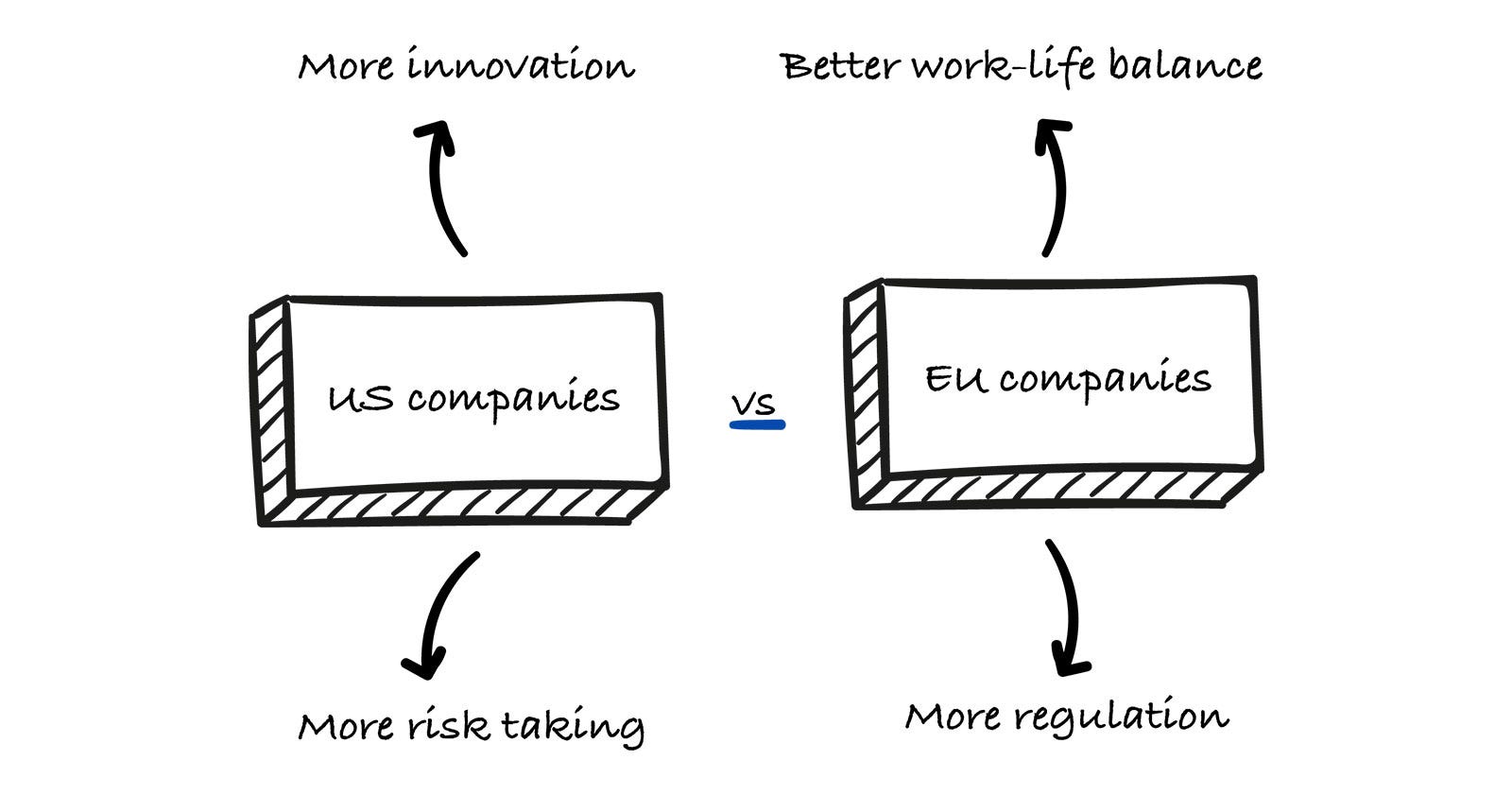
Difference #1 — US companies innovate a lot more than EU companies
The clearest pattern Gregor sees, and the one he felt most strongly during his SF trip:
- US companies (especially in SF) are constantly evolving and trying new things. There is a bias to action — people start moving even when no one is sure how it will turn out. Mistakes are treated as part of learning, not as failures to avoid.
- EU companies tend to operate from a different mental model: stability, predictability, and getting things "right" before moving forward. That can be the correct call in some industries, but it materially slows the rate at which new ideas ship.
A useful way to picture this: imagine two teams asked "should we try X?"
- The US-style team's default answer is "let's try a small version this week and see."
- The EU-style team's default answer is "let's first validate, align, and plan, then decide."
Both can be rational. They simply optimize for different things — speed and learning versus precision and reliability.
Gregor cites his own write-up on Weave, an AI-native SF startup, as an example of the US "ship and learn" mindset in action. (Linked from the original article.)
His personal verdict: in a world being reshaped by AI, where the rate of change has accelerated, speed and innovation are likely to matter more than precision over the next several years. Not because precision is bad, but because the cost of moving slowly is rising faster than the cost of being occasionally wrong.
Difference #2 — EU companies are far more risk-averse
This is the underlying engine behind Difference #1. The slower innovation isn't laziness; it's a deliberate desire to minimize risk.
What that looks like inside EU companies:
- Decisions are made more carefully; plans are more detailed.
- Before launching a new product, entering a new market, or making a strategic shift, there's typically a lot of validation, alignment, and internal consensus.
- Ideas have to make sense not only in theory, but also in terms of long-term sustainability — i.e., is this still a good idea in three years?
- Change itself is treated with caution. Even after a decision is made, it takes real time for the organization to accept the change emotionally, not just on paper.
In US companies, especially in SF, change feels almost the opposite — decisions get made overnight, sometimes with results that aren't guaranteed, and people are visibly comfortable with that ambiguity. Gregor admits some of those decisions felt rushed to him, but the cultural willingness to commit anyway is striking.
He summarizes the US attitude as "Go big or go home", and gives concrete examples of moves he's seen at US companies that he simply hasn't witnessed in the EU:
- Completely changing company direction overnight via a single email, with no detailed explanation.
- Letting go of half the engineering department in one stroke, with access shut off immediately.
- Setting extremely aggressive — often unrealistic — targets (revenue, growth, product timelines) and committing to them publicly.
Read these not as criticisms but as symptoms of risk tolerance. A company willing to do those things is also willing to make the bold bets that occasionally produce category-defining outcomes. The same company is also more likely to whiplash its employees.
The EU's risk aversion produces the mirror image: fewer dramatic moves, fewer category-defining swings, but also less collateral damage when something doesn't pan out. It optimizes for sustainability — the company, the team, and individual careers all expected to last.
Industry matters too: a heavily regulated EU fintech and a Berlin AI startup will sit at very different points on this spectrum. The pattern is a tendency, not a rule.
Difference #3 — Less self-confidence in EU companies (preview only)
Gregor begins his third point — that he sees noticeably less self-confidence in EU companies than in US ones — and frames it as the cause connecting the first two differences (less innovation, more risk aversion). The full argument is behind the paywall, so this summary stops here.
What's behind the paywall (not summarized)
The article continues with these sections, which were not accessible:
- I see a lot less self-confidence in EU companies in comparison to US companies (full discussion)
- Work-life balance is a lot better in EU companies
- US companies tend to let go of people faster
- Sales-oriented & "crushing the competition" mindset is prominent in US companies
- EU companies are dealing with a lot more regulation
- US companies raise a lot more capital a lot more quickly
- Last Words
If you want the full reasoning on confidence, work-life balance, layoffs, sales culture, regulation, and fundraising, you'll need a paid subscription to Engineering Leadership.
Takeaways from the accessible portion
- The US/EU divide Gregor describes is essentially one optimization function vs another: speed + innovation on one side, stability + sustainability on the other. Neither is inherently right.
- Risk tolerance is the hidden variable. Most surface-level differences (innovation pace, decision speed, willingness to pivot or lay off) trace back to how comfortable a culture is with uncertainty.
- Where you work shapes how you'll be evaluated. A "bias to action" engineer in a consensus-driven EU org will feel reckless; a "validate before moving" engineer in an SF startup will feel slow. Knowing the operating system of the company you're joining matters at least as much as the tech stack.
- In an AI-accelerated environment, Gregor's bet is that the speed-and-innovation operating model will pull ahead — but he leaves room for the EU model to remain the right call in domains where reliability and long-term thinking still dominate.
Author
Gregor Ojstersek
Continued reading
Keep your momentum
MKT1 Newsletter
100 B2B Startups, 100+ Stats, and 14 Graphs on Web, Social, and Content
This is Part 2 of MKT1's three-part State of B2B Marketing Report. Where Part 1 looked at teams and leadership , Part 2 turns to what marketing teams are actually doing — what their websites look like, how they use social, and what "content fuel" they're producing. Emily Kramer u
Apr 28 · 10m
Lenny's Newsletter (Lenny's Podcast)
Why Half of Product Managers Are in Trouble — Nikhyl Singhal on the AI Reinvention Threshold
Nikhyl Singhal is a serial founder and a former senior product executive at Meta, Google, and Credit Karma . Today he runs The Skip ( skip.show (https://skip.show)), a community for senior product leaders, plus offshoots like Skip Community , Skip Coach , and Skip.help . Lenny de
Apr 27 · 7m
The AI Corner
The AI Agent That Thinks Like Jensen Huang, Elon Musk, and Dario Amodei
Dominguez opens with a claim that is easy to skim past but worth stopping on: the difference between elite founders and everyone else is not raw IQ or speed — it is that each of them has internalized a repeatable mental procedure they run on every important decision. The procedur
Apr 27 · 6m