The VC Corner
The US VC Database Most Founders Never Build
Ruben Dominguez
Apr 21, 2026
The US VC Database Most Founders Never Build
Source: The VC Corner · Author: Ruben Dominguez · Date: Apr 21, 2026 · Original link
Note: This post is largely a promotional / paywalled piece. The free portion is essentially a sales page for a premium database; the actual database (the "meat") sits behind a paywall. The summary below captures the full accessible content and the lesson embedded in the pitch — which is genuinely useful for any founder about to raise.
What the post is actually about
If you're a founder raising a pre-seed or seed round in the US, the single most time-consuming chore is not writing the pitch deck or perfecting the financial model. It's building the investor list — the spreadsheet of VC firms you're going to email, intro into, and track through your raise.
The post argues that most founders build this list the painful way: Googling firm names one by one, opening Crunchbase, checking each fund's website to see if they're "still active" (many funds quietly stop deploying capital between fund cycles), then trying to figure out which specific partner at the firm actually writes early-stage checks — because at most multi-stage funds, only a subset of partners lead pre-seed/seed. People end up doing this at 2am for weeks. It's the kind of work that feels like progress but isn't moving the round forward.
The post's pitch: skip that grind by buying access to a pre-built database of 2,000 active US VC firms covering pre-seed and seed across every sector.
Why an investor list is worth taking seriously (the underlying lesson)
Even setting the sales pitch aside, there's a real founder lesson here worth absorbing:
The founders who close rounds fastest are the ones who spend the least time researching and the most time in actual investor conversations.
The reasoning: fundraising is a numbers game compressed into a narrow time window. Momentum matters — if your raise drags out for months, signal goes negative ("why is this still open?"). So every hour you spend on list-building is an hour not spent on the activity that actually closes the round: meetings, follow-ups, and reference building. A "good enough" list you can start emailing today beats a perfect list ready in three weeks.
That's why founders who've raised before tend to either (a) reuse and recycle a list from prior rounds, (b) buy a list, or (c) crowdsource one from other founders — rather than rebuild from zero.
What the paid database claims to include
For each of the ~2,000 firms, an entry contains:
- Fund name
- Portfolio companies (so you can quickly check thesis fit and look for warm-intro paths via founders you know)
- Fund type (e.g. traditional VC, micro-VC, solo GP, corporate VC)
- Stage focus (pre-seed, seed, etc.)
- Sector / focus area
- Location
- LinkedIn and Twitter handles
- Number of investments and number of exits (a rough proxy for activity and track record)
- Founding year of the firm
- Full fund description
The data is meant to be filterable, sortable, and exportable — i.e. you load it into a spreadsheet or CRM, slice by stage + sector + geography, and get a working target list in minutes instead of weeks.
The bigger bundle being sold
The database is one piece of a broader paid offering on The VC Corner. The post lists what subscribers get:
- The full 2,000 US VC firms database
- A wider directory of 10,000+ venture capital investors across stages, sectors, and geographies
- Hundreds of real pitch decks from companies that raised significant rounds
- Dozens of financial models built for founders and operators
- The publication's library of frameworks, playbooks, and templates
Pricing pitch: 7-day free trial, 50% off forever for first subscribers, cancel anytime.
Takeaways for a founder reading this
Whether or not you buy this specific product, the post is a useful nudge to internalize three things before your next raise:
- Treat your investor list as infrastructure, not homework. Build (or buy) it once, keep it updated, and reuse it across rounds and for warm intros to other founders. It compounds.
- Filter aggressively before outreach. Stage fit and sector fit are non-negotiable; geography and check size matter; everything else is noise. Sending to 500 mismatched firms is worse than sending to 50 well-targeted ones — you'll burn your reputation and your time.
- Identify the right partner, not just the right firm. A "yes" from a junior associate at a top fund is rarely a yes; an intro to the partner who writes pre-seed checks is. Any list you use should make that lookup easy.
What's behind the paywall
The actual database itself — the spreadsheet with the 2,000 firms — is gated. The free portion of the article ends just before the data, with a "Keep reading with a 7-day free trial" prompt. So this summary covers everything publicly accessible; the value of the product itself can only be evaluated by trialing it.
Author
Ruben Dominguez
Continued reading
Keep your momentum
MKT1 Newsletter
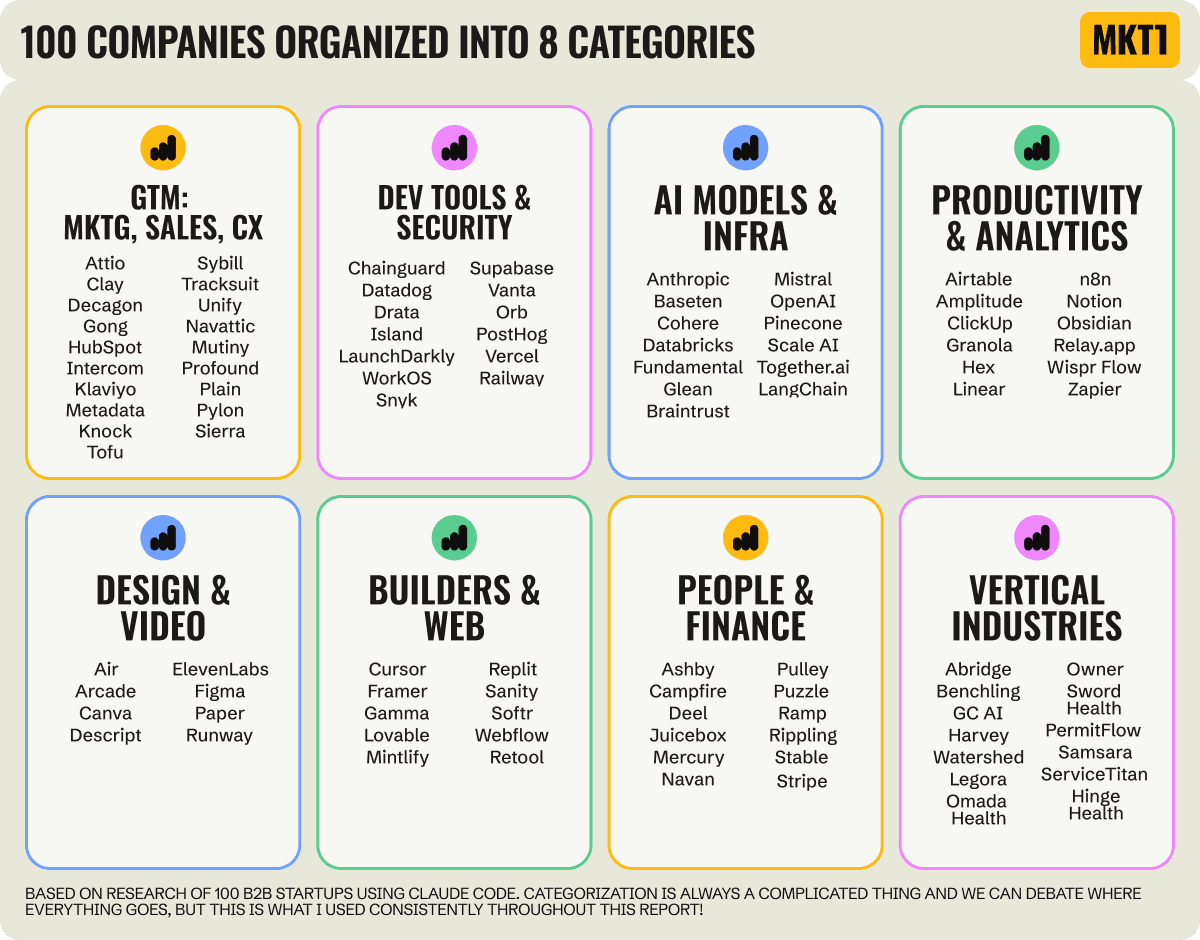
100 B2B Startups, 100+ Stats, and 14 Graphs on Web, Social, and Content
This is Part 2 of MKT1's three-part State of B2B Marketing Report. Where Part 1 looked at teams and leadership , Part 2 turns to what marketing teams are actually doing — what their websites look like, how they use social, and what "content fuel" they're producing. Emily Kramer u
Apr 28 · 10m
Lenny's Newsletter (Lenny's Podcast)
Why Half of Product Managers Are in Trouble — Nikhyl Singhal on the AI Reinvention Threshold
Nikhyl Singhal is a serial founder and a former senior product executive at Meta, Google, and Credit Karma . Today he runs The Skip ( skip.show (https://skip.show)), a community for senior product leaders, plus offshoots like Skip Community , Skip Coach , and Skip.help . Lenny de
Apr 27 · 7m

The AI Corner
The AI Agent That Thinks Like Jensen Huang, Elon Musk, and Dario Amodei
Dominguez opens with a claim that is easy to skim past but worth stopping on: the difference between elite founders and everyone else is not raw IQ or speed — it is that each of them has internalized a repeatable mental procedure they run on every important decision. The procedur
Apr 27 · 6m