MKT1 Newsletter
The State of B2B Marketing Teams: What 100 High-Growth Startups Reveal
Emily Kramer
Apr 21, 2026
The State of B2B Marketing Teams: What 100 High-Growth Startups Reveal
Source: MKT1 Newsletter · Author: Emily Kramer · Date: Apr 21, 2026 · Original article
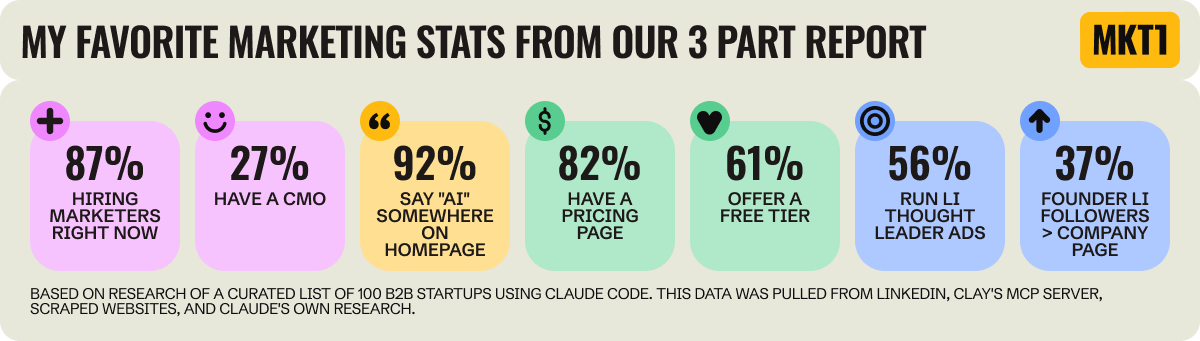
Part 1 of a 3-part series. 19 graphs covering team size, leadership titles, hiring, JD language, and tool mentions across 100 B2B startups (seed → public).
How this report came to be
A founder asked Emily a simple advisory question: "If we want to start a B2B newsletter, what platform should we use?" Normally her brain blanks on a list of comparable companies. So she did what an advisor in 2026 does — she opened Claude Code, built a curated list of 100 fast-growing, forward-thinking B2B companies (seed-stage to recently public), and wrote a "skill" that researches all of them at once. She kept adding data points until she had 90+ per company, blew past the $100 Claude plan into the $200 tier, and ended up with ~30 graphs.
The whole point — and a recurring theme — is that this isn't AI slop. She spot-checked data, fixed graphs by hand, and re-ran the skill iteratively. Part 3 of the series will explain how to produce researched work like this and ship it as an MCP Server skill (not just dump a Claude Chat into a doc).
Methodology, in plain English
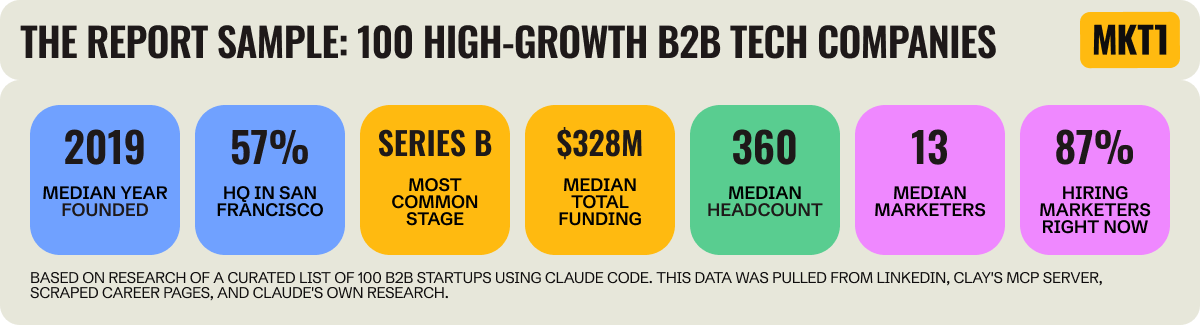
- Sample: 100 B2B startups, mostly venture-backed, seed → IPO, concentrated in growth-stage. Targeted recent fundraisers, "startup to watch" lists, and default-known B2B tools. Heavy AI tilt because that's where the money is flowing.
- It's curated, not random. Biased toward "hot" companies — so more are hiring than the average startup. Treat the data as directional, not statistically significant.
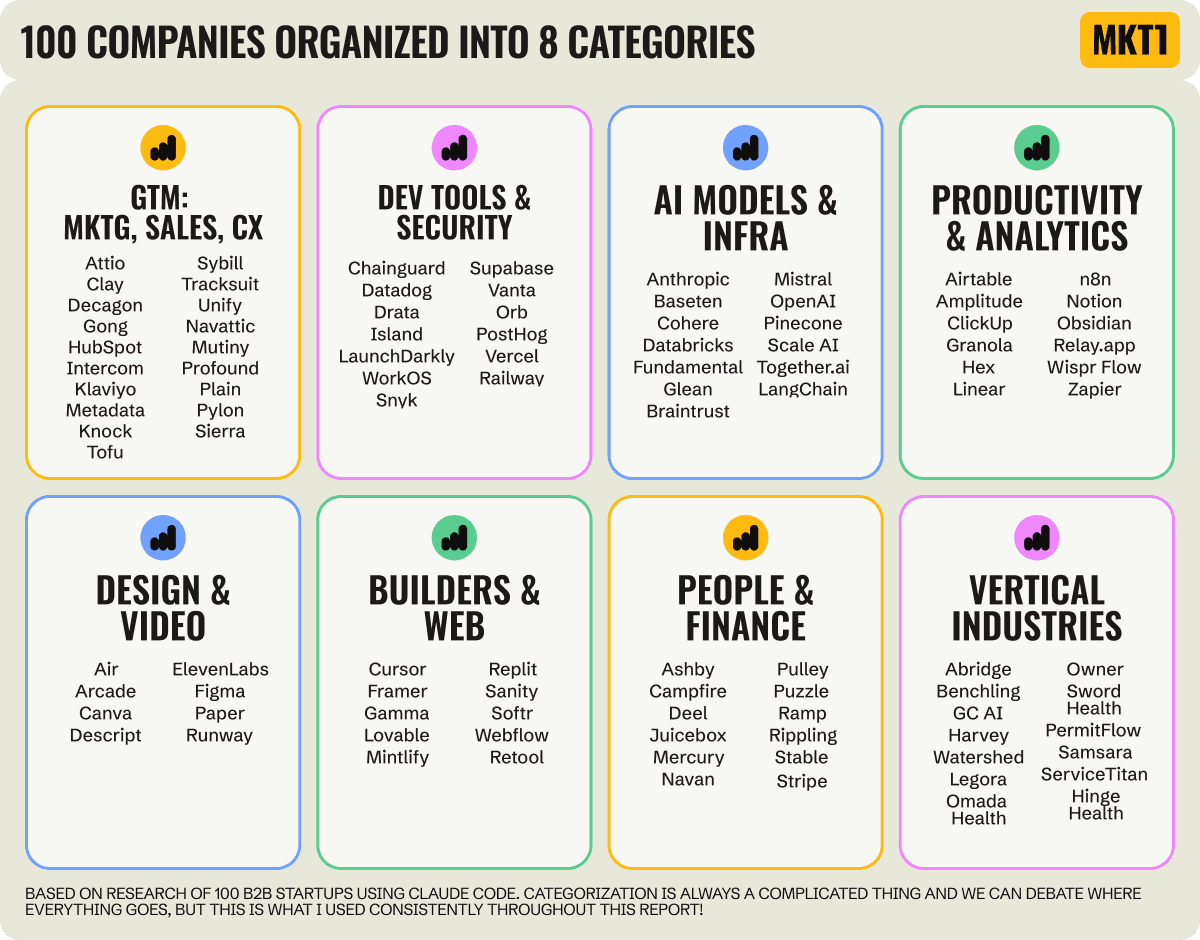
- Companies were grouped 8 ways by audience (e.g., "sells to marketers," "sells to sales," "AI infra," etc.). Bucketing companies is "a fool's errand," but the cuts are useful.
- Data sources: scraped via Claude Code using MCP servers (Figma, Clay, Attio, Airtable, MKT1's own MCP). Pulled LinkedIn, careers pages, web pages, ad libraries.
Why she also slices by GTM motion (not just by company size)
Most marketers benchmark against "companies our size." But two other cuts often matter more:
- GTM motion = how customers actually buy.
- Self-serve: you can buy without ever talking to sales (close to PLG, but not identical).
- Sales-led: you're getting a demo whether you want one or not — most buyers go through a rep.
- Hybrid: both paths exist; the route depends on deal size or use case.
- Category = what you sell and to whom. Vertical plays (Harvey for legal, Abridge for health) tend to be sales-led because the TAM is narrower and buyers expect a relationship.
Emily's recurring warning: marketers often try to run a self-serve playbook at a sales-led company (or vice versa) and fail. Throughout the report, GTM motion changes the answer.
The State of Marketing Team Size
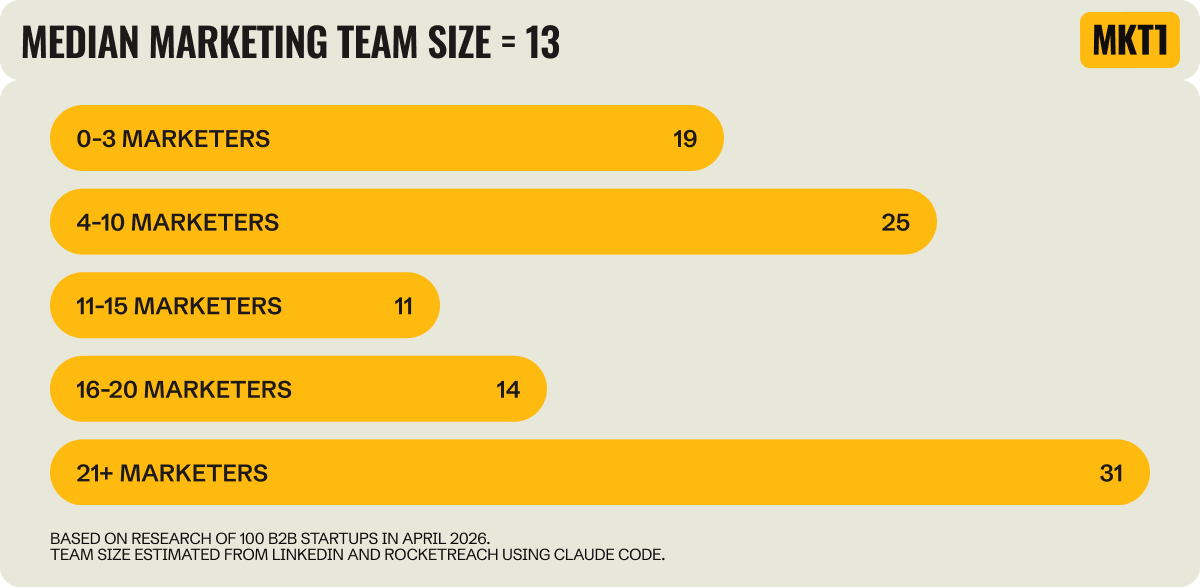
How big are marketing teams right now?
- Median: 13 marketers. Mean: 44. (Median = the middle value when sorted; mean = the average. The huge teams at Canva and HubSpot — hundreds of marketers — drag the average way up, which is why she uses median throughout.)
- Marketing is ~4% of total company headcount (median 4%, mean 4.4%). Emily had long quoted ~5% as her benchmark and even fought for that ratio when she led teams. Reality came in slightly lower.
- She expects the ratio to stay roughly steady even as AI shrinks marketing teams — because AI will shrink other functions too.
How team size shifts by stage, category, and GTM motion
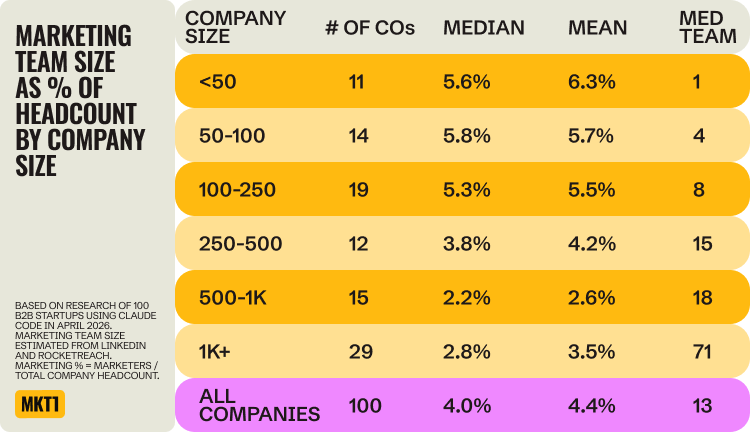
- Below 250 employees, marketing is 5%+ of headcount. Above 250, it's a stable 2–4%. So as a company grows, the marketing team grows in absolute terms but shrinks as a share. (Caveat: the "1K+" bucket lumps 1,000- and 15,000-person companies together, which makes the median look like it jumps.)
- Companies that sell to marketers staff up the most. The 8 companies whose customers are marketers run marketing at a median 8.3% of headcount, vs. 3.8% for everyone else. Practicing what they preach.
- Companies that sell to sales teams hire the fewest marketers — just 2.9% of headcount. Possibly the in-house sales muscle picks up the marketing slack.
- Self-serve companies have the biggest marketing teams — 5.6% of headcount. Counterintuitive: Emily expected hybrid (widest channel mix, most ops complexity) to win. But when there's no sales team, marketers carry more of the load.
- Any self-serve motion (pure self-serve + hybrid): median 4.3%.
- Pure sales-led (23 companies): median 3.2%.
🥤 Takeaway: 2–4% of headcount is the typical range, but GTM motion, category, and founder taste swing the actual number a lot. There's no clean universal benchmark.
🎯 Favorite stat: "Sells to marketers" companies run 2x+ the marketing-headcount ratio of everyone else. The fast-growers in this sample are leaning into marketing as a moat — when products are easier than ever to build, distribution and brand might be the real defensibility.
The State of Marketing Leadership
In Emily's experience, healthy marketing orgs have one person owning the whole function with the right title and real scope. Otherwise you get silos, gaps, and what she calls "random acts of marketing."
What titles do leaders running all of marketing carry?
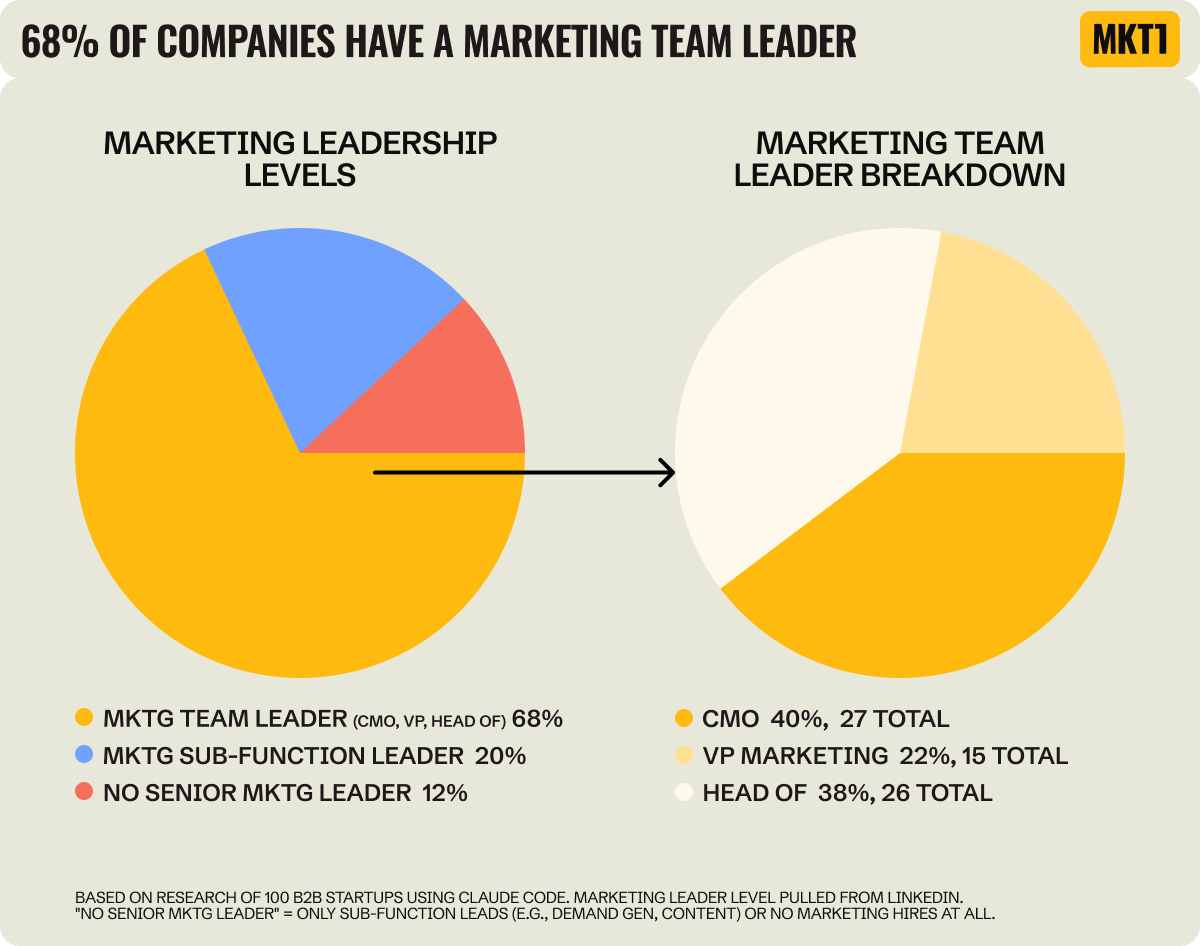
(Note: this counts only the senior-most marketing title at each company. A company with a CMO probably also has VPs.)
- 68% of companies have a single person leading all of marketing — but the title varies (Head of, VP, CMO).
- Early stage is fragmented. 40% of companies with <$50M raised have no unified marketing leader at all. Of those, half have someone running just a sub-function (content, demand gen); the other half have made zero marketing hires yet.
- Only 2 companies under $100M raised have a CMO — Puzzle and Wispr Flow.
- By $500M+ raised, 81% have a unified marketing leader and 45% have a CMO.
- CMO is a rare title. Across all 100 fast-growing companies, only 27 CMOs. If you have the title, you're an anomaly — and without it, marketing leaders are often under-leveled on comp.
CMOs vs. CROs — who has the seat at the table?
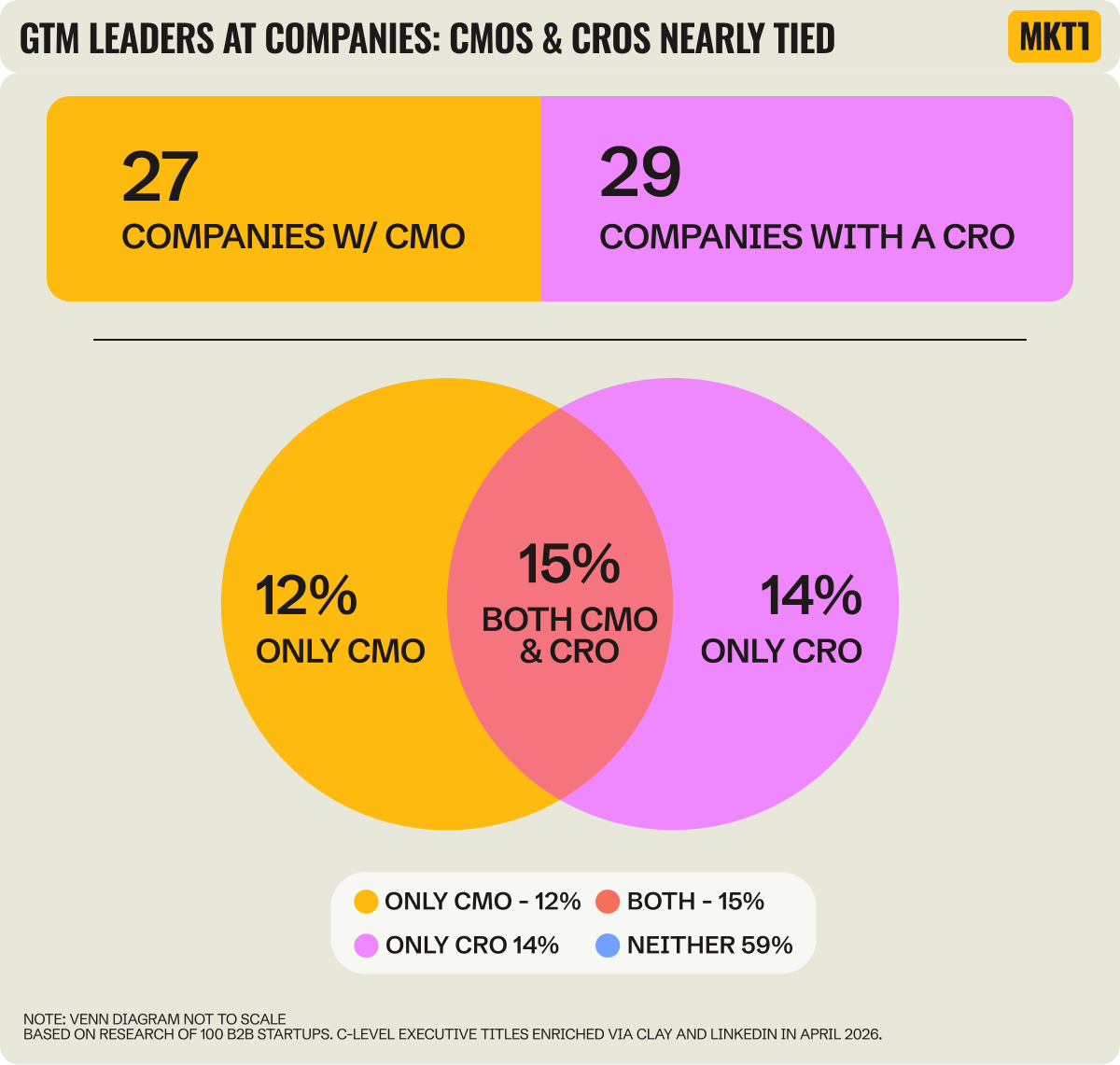
- 59 of 100 companies have neither a CMO nor a CRO. C-suite GTM titles are mostly a late-stage thing — three-quarters of those 59 have raised under $500M.
- 15 companies have both a CMO and a CRO — all late-stage and mature (Benchling, Chainguard, Datadog, Figma, etc.).
- CMOs and CROs are nearly tied: 27 CMOs, 29 CROs. Emily expected CROs to dominate; they don't, much.
- CRO-only companies (14) skew sales-led and AI infra (Cohere, Rippling, ServiceTitan).
🥤 Takeaway: Plenty of B2B companies grow fast without a CMO. Would they grow faster with one? Emily thinks yes, but the data can't prove it. Marketers deserve the same C-level seat as a sales leader — that's a values stance, not a stats claim.
🎯 Favorite stat: Only companies with $50M+ raised have anyone with the CMO title. Don't expect the C-title until there's real money in the bank — even if you're already doing the job.
The State of Marketing Hiring
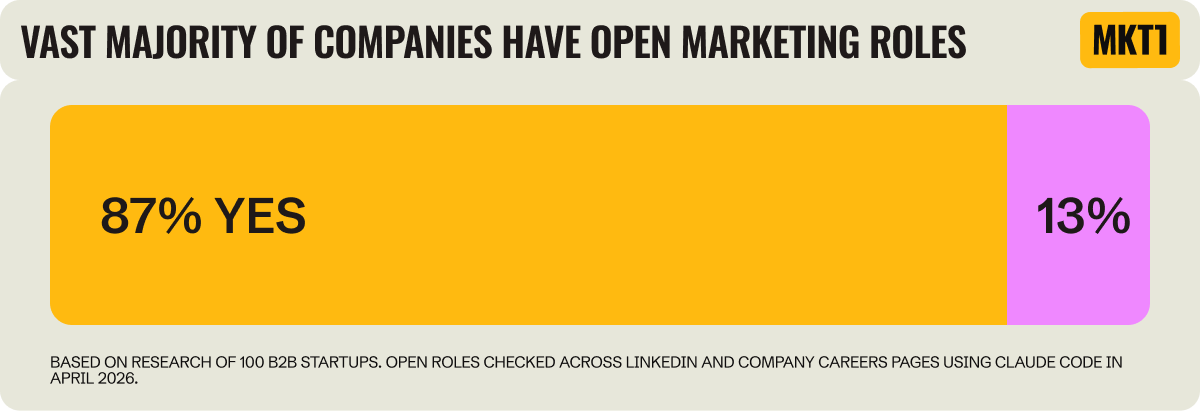
Are companies actually hiring marketers?
- Yes — 87 of 100 companies have open marketing roles, totaling 507 open roles (~6 per company on average).
- 85% of open roles sit at companies with $250M+ raised.
- 100% of companies with $500M+ raised are hiring marketers right now. All 42 late-stage companies have at least one open marketing seat. Heavy hitters: Anthropic, OpenAI, Stripe, Deel, Datadog, Rippling — each with 20+ roles open.
- The 13% not hiring skew small/early (Paper, Obsidian, Navattic).
Marketing vs. sales hiring
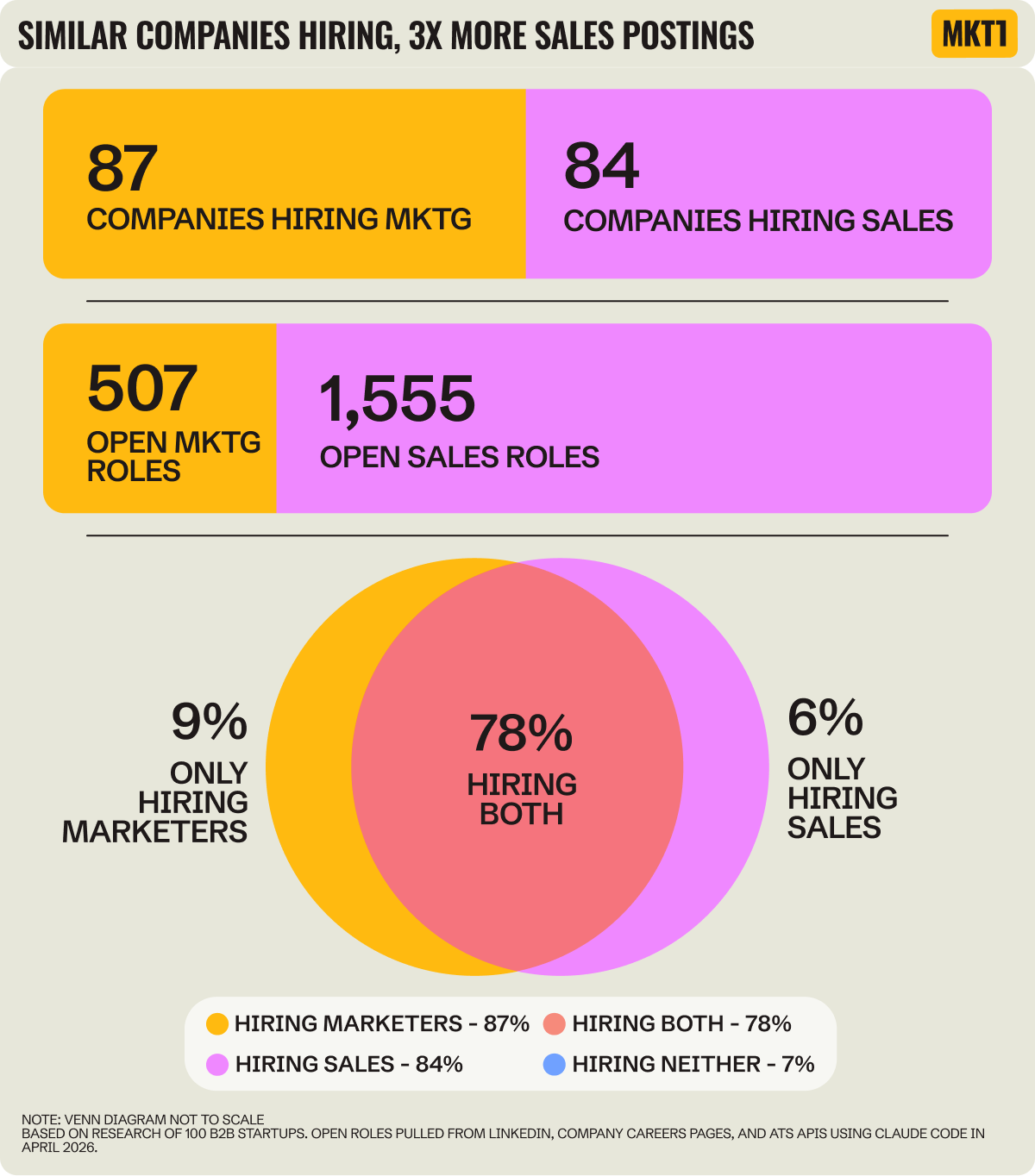
- 78% of companies are hiring for both marketing and sales. (87 hiring marketing, 84 hiring sales, 7 hiring neither.)
- 3x more open sales roles than marketing roles — but it's heavily skewed by Rippling (hundreds of sales roles), Datadog, and HubSpot (100+ each). Strip those three outliers and the ratio shrinks to about 1.5x.
- Sales role counts are noisy anyway: one "AE" listing might cover 5 hires; conversely, regional duplicates may be the same role posted three times. The more reliable signal is the count of companies hiring for each function, not the raw role count.
Which marketing functions are hottest?
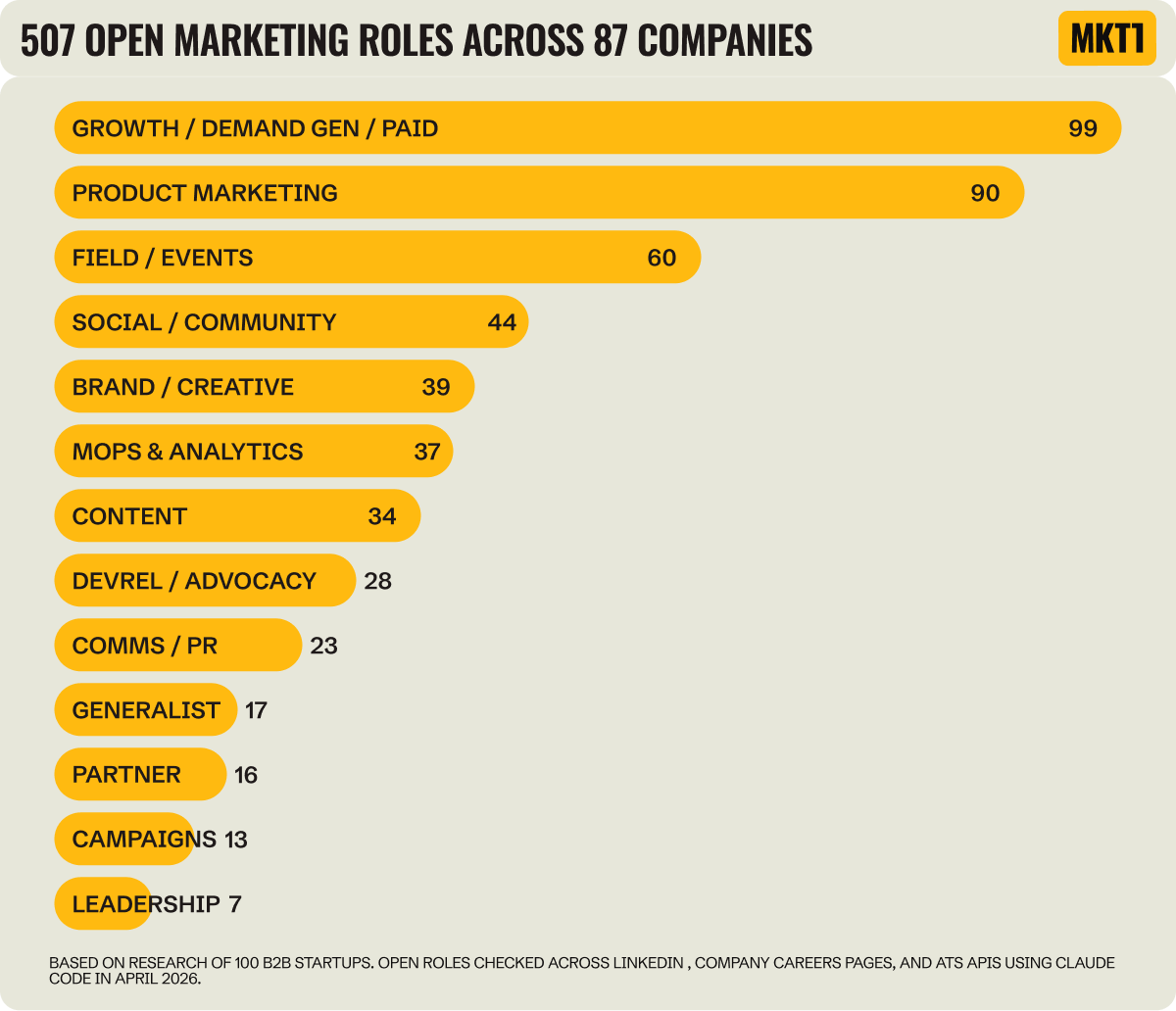
- Growth / Demand Gen / Paid leads with 99 open roles. Product Marketing right behind at 90. Together: 37% of all open marketing roles.
- 34% of open roles are in ecosystem and events — a huge tell about what's working in 2026. With inbound declining, outbound saturated, and AI slop everywhere, human interactions and recommendations matter more.
- Field/Events is the #3 bucket with 60 open roles. 5 years ago — peak Covid — that would've been unimaginable.
- Adding it up: Partner (16) + Social/Community (44) + DevRel/Advocacy (28) + Comms/PR (23) ≈ 100+ roles. Companies are hiring marketers to orchestrate trust — through partners, creators, communities, and media — because that's the credibility shortcut when AI-generated content is everywhere.
What JDs say in the AI era
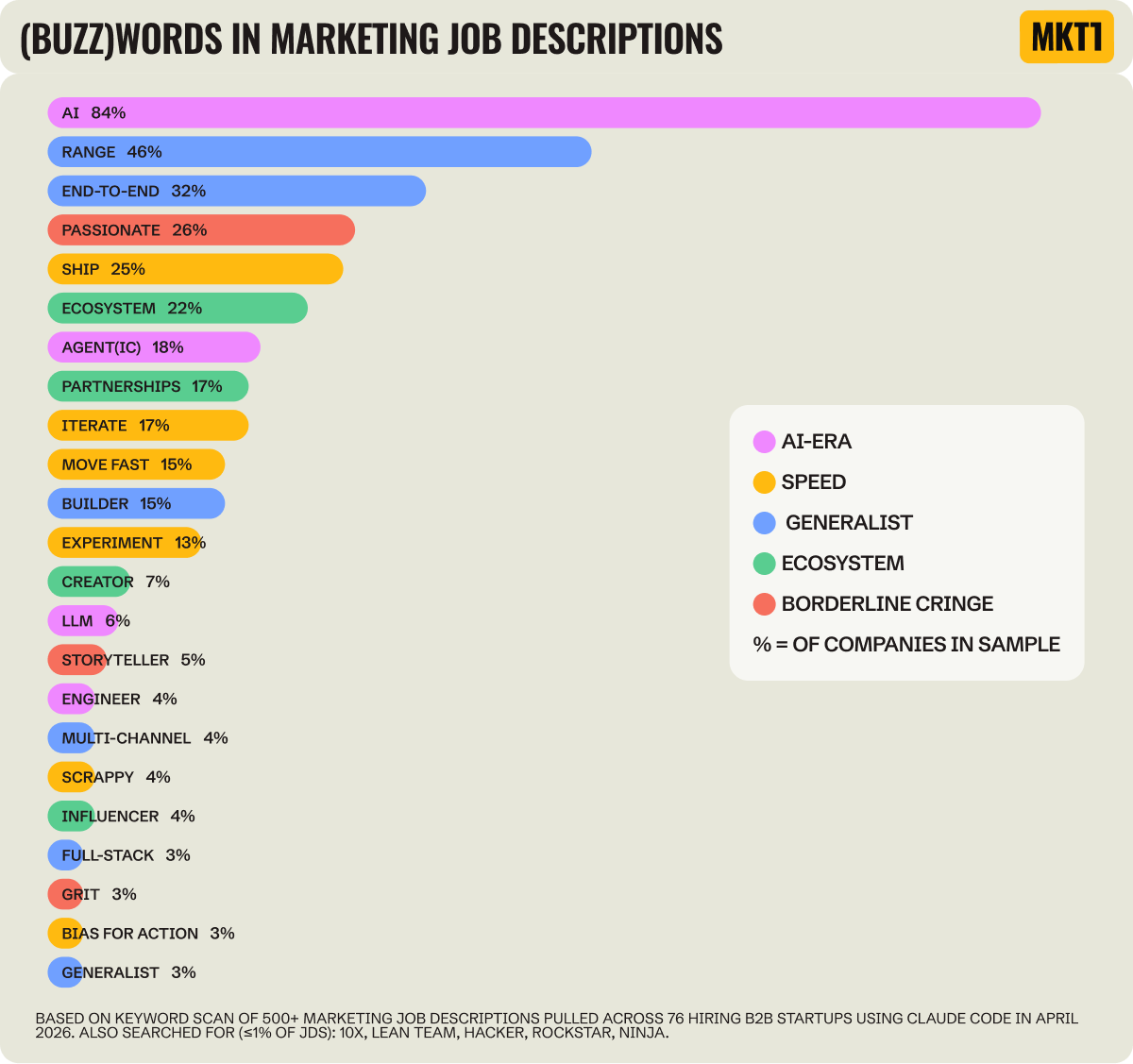
- 84% of JDs mention "AI." 18% mention "agent" or "agentic." 6% mention "LLM." If your JD doesn't mention AI, you're the minority.
- A few very AI-forward companies (Framer, Railway) don't mention AI in JDs — possibly because it's so default it doesn't need to be said.
- The new cringe vocabulary: "ninja," "rockstar," and "hacker" are mercifully gone. The new offenders: "passionate" (26%), "grit" (3%), "hungry" (1%). Emily also throws "storyteller" in the cringe pile (blame the WSJ).
What tools do JDs name-drop?
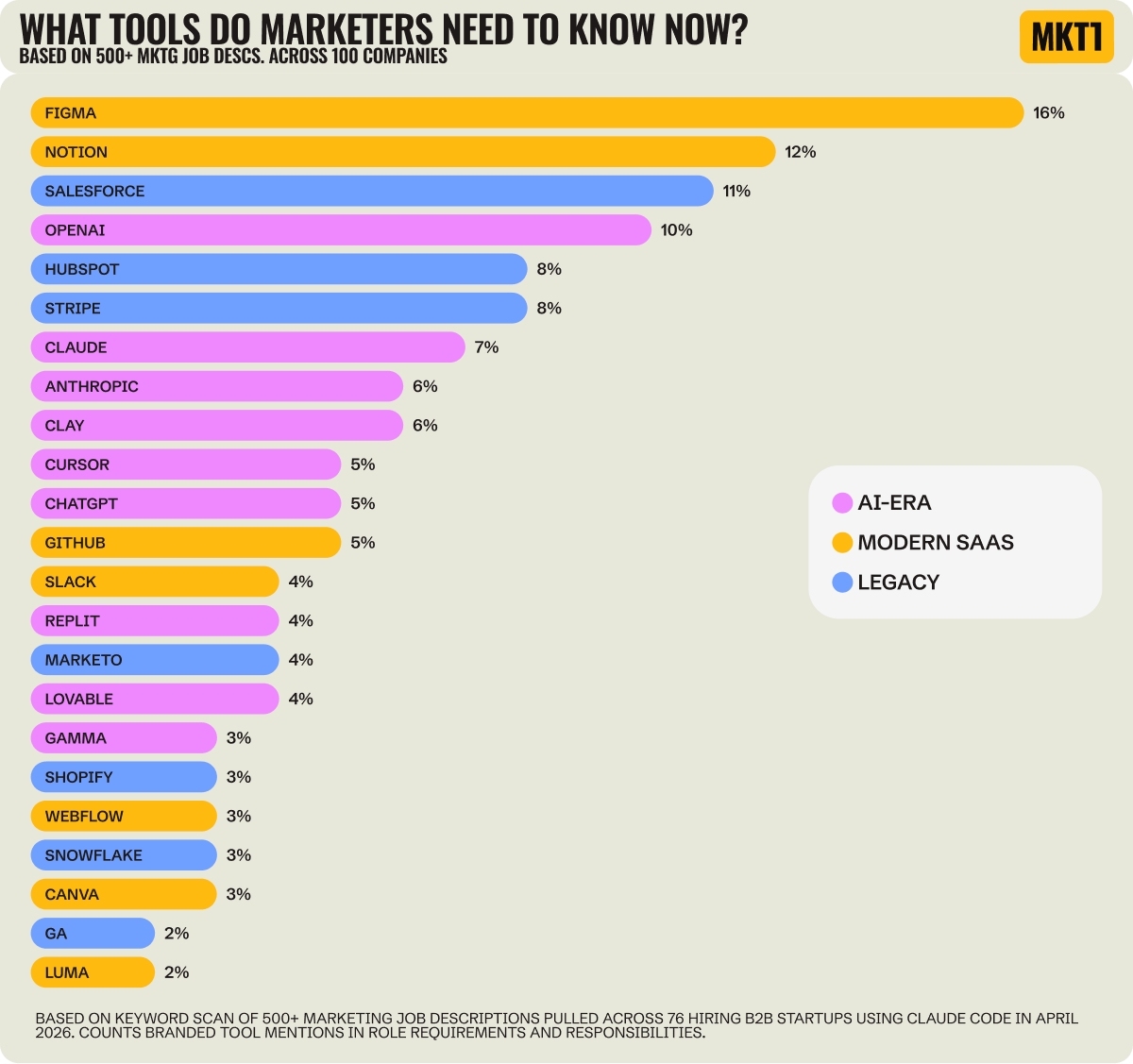
- #1 Figma (16%), #2 Notion. Surprising given how many marketers prefer Canva. (All the report's graphs were made in Figma via the Figma MCP in Claude Code, plus heavy manual editing.)
- Big caveat: when a well-branded tool appears in a JD, some mentions are name-drops as social proof (customer lists, shared investors), not actual tool requirements. Stripe at #6 is mostly customer name-drops, not real usage. Some of Figma's 16% is the same — Notion, Hex, and Sanity all name-drop Figma.
- AI labs collectively dominate. OpenAI 10%, Claude 7%, Anthropic 6%, ChatGPT 5%. Each is roughly as common as HubSpot (8%) or Salesforce (11%). Lump them together and AI labs are the most-mentioned tool category in marketing JDs.
- AI-native tools show up but lighter than expected: Clay (6%), Cursor (5%), Replit (4%), Lovable (4%), Gamma (3%).
- Marketo (4%) is still alive — same frequency as Slack and GitHub.
The marketing roles of the future
Emily has been writing about the "Gen Marketer" archetype — an AI-powered generalist who runs cross-channel campaigns and works fluently with agents. The scraped data surfaced concrete examples of these roles:
- Ramp — Agentic Operator, Growth Marketing. Asks for fluency in agentic AI, MCP, and evals. A JD that wouldn't have made sense 12 months earlier.
- Cursor — Marketing Systems Lead. Marketing ops reframed as systems architecture. On-brand for an AI coding tool.
- Clay — Chief of Staff, Marketing. (Lovable has the same role.) Emily has long advocated for a CoS in marketing — under different names — to land headcount. A perfect Gen Marketer slot.
- Airtable — Program Manager, AI Programs. A dedicated role just for AI-specific marketing programs.
- Lovable — Field Marketing Lead, Hackathon. A new field-marketing archetype: events specifically for builder/developer hackathons.
- Gamma — Product Evangelist. A blend of product marketing, content, and DevRel. Anthropic and Lovable hire for "Evangelist" too — PLG, AI-first companies need a new way to educate the market.
🥤 Takeaway: There are jobs out there, and yes you need AI skills to get them. JDs are loaded with AI tools and buzzwords, but titles haven't caught up — companies are still hiring specialist titles. Emily expects the next run of this report to show more generalist, campaign-lead, and marketing-CoS titles.
🎯 Favorite stats: 100% of $500M+ companies are hiring marketers; ~1/3 of open marketing roles are in ecosystem/events functions. The non-paid, non-inbound, human-trust channels are doing the heavy lifting in 2026.
The bigger meta-point
What's actually new isn't the data — it's that a single advisor can now research her own benchmark report in a week and ship it as a reusable skill. Emily turned this dataset into two skills on the MKT1 MCP Server:
/state-of-b2b-marketing— query the full 100-company dataset (90+ data points each: GTM motion, team comp, social, ads, homepages, CMS, conversion, AEO readiness)./high-growth-b2b-company-list— a curated list of 150 high-growth B2B companies as a reusable reference set, so you don't start every research task from scratch.
The pattern she's modeling: research done in Claude → packaged as a skill → distributed to customers in Claude → immediately actionable. Claude is both the fuel (the research) and the engine (the distribution). Parts 2 and 3 of the series cover marketing activities (especially social and web) and the how-to of producing reports like this without it being AI slop.
Author
Emily Kramer
Continued reading
Keep your momentum
MKT1 Newsletter
100 B2B Startups, 100+ Stats, and 14 Graphs on Web, Social, and Content
This is Part 2 of MKT1's three-part State of B2B Marketing Report. Where Part 1 looked at teams and leadership , Part 2 turns to what marketing teams are actually doing — what their websites look like, how they use social, and what "content fuel" they're producing. Emily Kramer u
Apr 28 · 10m
Lenny's Newsletter (Lenny's Podcast)
Why Half of Product Managers Are in Trouble — Nikhyl Singhal on the AI Reinvention Threshold
Nikhyl Singhal is a serial founder and a former senior product executive at Meta, Google, and Credit Karma . Today he runs The Skip ( skip.show (https://skip.show)), a community for senior product leaders, plus offshoots like Skip Community , Skip Coach , and Skip.help . Lenny de
Apr 27 · 7m

The AI Corner
The AI Agent That Thinks Like Jensen Huang, Elon Musk, and Dario Amodei
Dominguez opens with a claim that is easy to skim past but worth stopping on: the difference between elite founders and everyone else is not raw IQ or speed — it is that each of them has internalized a repeatable mental procedure they run on every important decision. The procedur
Apr 27 · 6m