[The VC Corner](https://www.thevccorner.com/p/startup-growth-guide-2026)
The Only Startup Growth Guide You'll Need in 2026
Ruben Dominguez
Apr 27, 2026
The Only Startup Growth Guide You'll Need in 2026
Source: The VC Corner · Author: Ruben Dominguez · Date: April 27, 2026 · Original article

Why this guide exists
In 2026, ideas are cheap. A founder can read a blog post in the morning, brainstorm with AI at lunch, vibecode a prototype by dinner, and have a product in front of thousands of users by midnight. That speed is intoxicating — and it is exactly why so many founders confuse motion with progress. Numbers go up, dashboards get busy, and the team starts to believe the company is working. A lot of the time, it isn't. Most of what we call "growth" today is people passing through: users testing your tool for five minutes and clicking away to the next shiny thing.
The hardest skill in 2026 is not building. It is having the courage to look at your numbers honestly and see whether anyone is actually staying. Most struggling teams don't need a new tactic — they need to stop ignoring the signals that something is wrong. This guide walks through how to read those signals.
1. Traction is not evidence
It's easy to mistake a busy dashboard for a healthy company. Downloads climb, subscriptions tick up, revenue spikes — and you start to feel like the next Jensen Huang. But numbers can be loud without being meaningful. A surge in traffic usually just means you spent money or got lucky with an algorithm. The real question is whether that activity is turning into a habit.
The leaky bucket. Imagine pouring water into a bucket with a hole in the bottom. As long as you keep pouring (paid marketing, launch buzz, a viral moment), the water level looks healthy. The instant you stop pouring, the level drops. If thousands of people try your app but only a handful return next week, you're not growing — you're filling a bucket with a hole.
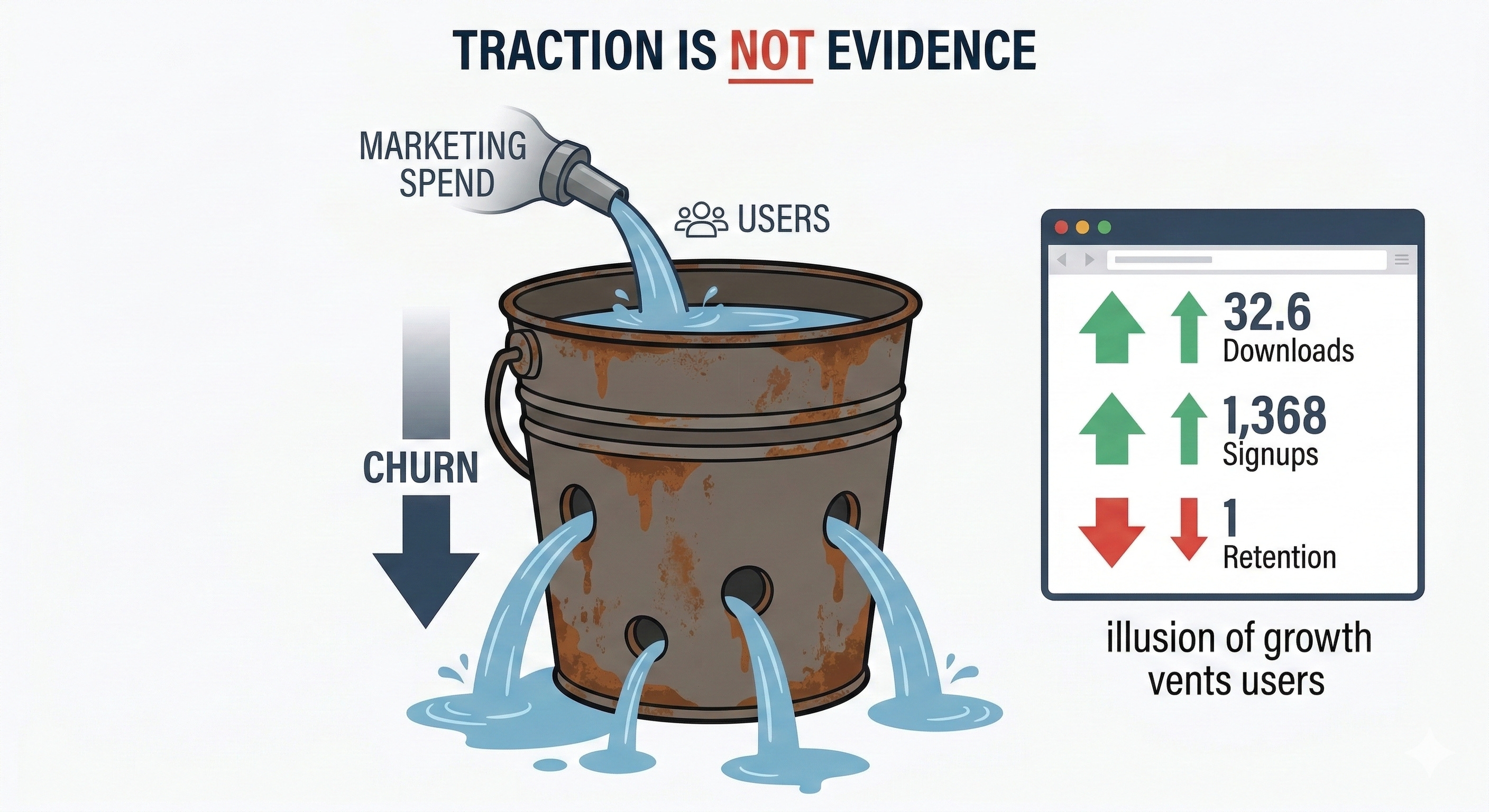
The only honest way to know if your growth is real is to look at what users do after the first day. This is why investors run cohort analysis — they group users by the week or month they signed up and watch how each group behaves over time. If your newest cohort is less engaged than the cohort from six months ago, you're losing ground even while topline numbers rise.
A healthy startup isn't constantly chasing new logos. It finds a group of people who genuinely cannot imagine going back to the old way. So before you spend more on marketing, ask the diagnostic question: what happens if I turn off the faucet? If growth stops the second the spending stops, you are renting users, not owning a market.
2. The real math of keeping users
Most growth conversations focus on acquisition because acquisition feels controllable — you spend money, the meter moves. Retention is harder. It moves slowly and forces an uncomfortable question: does my product solve a persistent problem well enough that people come back without being pushed?
Here's the math that catches up with you. If you lose 8% of customers every month, the average customer stays roughly a year. If it takes 14 months of revenue to earn back what you spent acquiring them, you lose money on every single signup. A growing top line can hide this for a while, but eventually the spreadsheet wins.
This is also why Lifetime Value (LTV) is dangerous when it's a guess. Founders look at their first few delighted users — early adopters who would have stayed no matter what — and project that loyalty onto everyone. Without retention data from newer cohorts, LTV is just a hopeful number on a slide.
Reading the retention curve
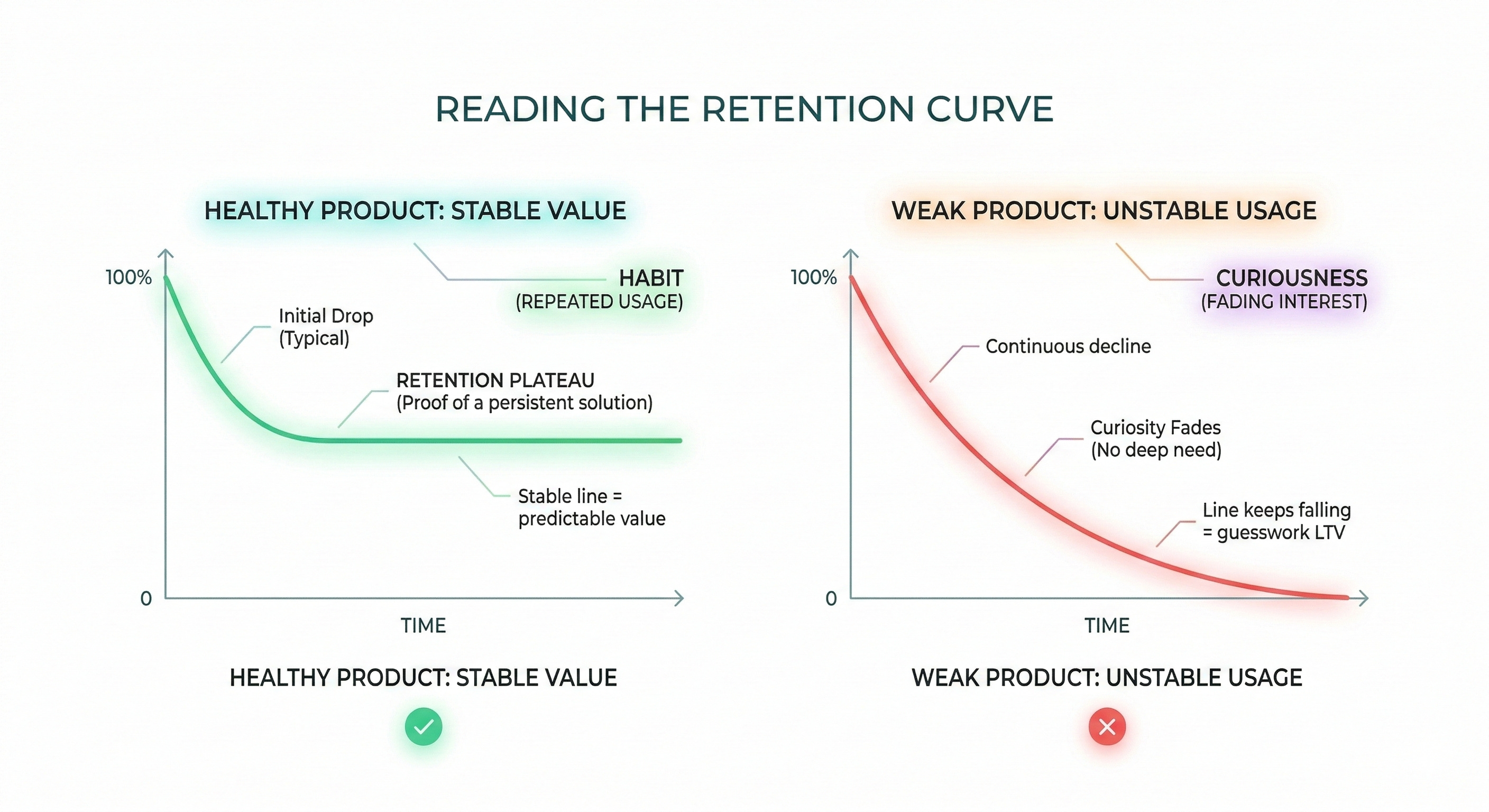
When you plot a cohort over time, you want the curve to flatten. A flat tail means the users who stayed have folded the product into their routine — it is part of how they work now. A curve that keeps decaying toward zero means you have a product people are curious about but don't truly need. No amount of new acquisition can fix this; you'd just be feeding more users into the same hole.
The trap of passive satisfaction
The most dangerous state isn't loud unhappiness — it's the kind-of-satisfied user. They log in occasionally, give mild praise, never complain. Usage doesn't deepen, churn quietly accumulates, and revenue decay only becomes visible when it's too late to fix cheaply.
The principle to remember: acquisition amplifies the retention profile you already have. Strong retention compounds growth. Weak retention accelerates leakage. Pouring money into the top of the funnel doesn't fix a weak product — it just makes the leak more expensive.
3. Startup growth hacks in 2026: what really works
The phrase "growth hacking" still excites people because it implies a shortcut. Those shortcuts genuinely existed a decade ago, when ad platforms were new, attention was cheap, and being early or loud was an edge. That world is gone. Ad platforms have gotten ruthlessly efficient at extracting your money. Algorithms now reward real engagement over clicks. And because anyone can use AI to flood the internet with content, simply being loud has become the baseline, not an advantage.

What actually works now
Real "growth hacking" in 2026 happens inside the product. Improving a user's first five minutes — what they see, how fast they hit value, how little friction is in the way — typically does more for the bottom line than any marketing campaign. When people get value quickly, they stay longer and tell others naturally. It's not a quick fix; it's the slow work of making sure the product actually delivers what it promises.
Building a moat instead of chasing trends
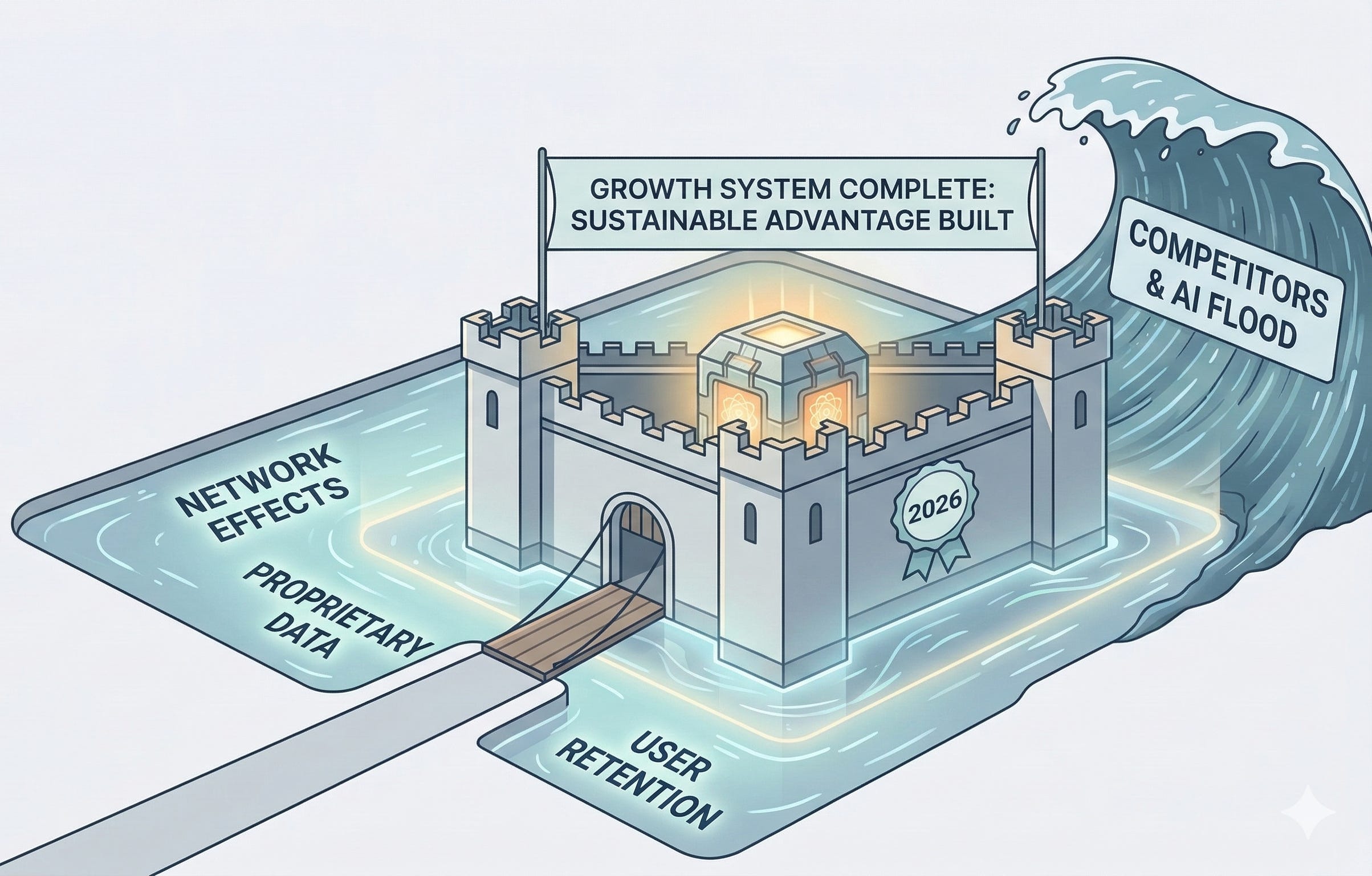
Stop chasing the next viral channel and start building things that are hard to copy:
- Founder-led distribution. People trust a person more than a faceless brand. A founder who shows up consistently with their own voice builds a channel competitors can't clone.
- Narrow focus. A message tuned to one specific group of people lands harder than a generic pitch aimed at everyone.
- Growth as a product feature. The most successful teams treat growth as part of the product itself — not a marketing layer added at the end. They win by being better, not by being everywhere.
4. How to strategize for growth in 2026
When founders write growth plans, they tend to produce long lists: every social channel, multiple ad platforms, complicated funnels. The companies that actually scale do the opposite — they choose to do fewer things better.
Know your true customer
Strategy starts with a precise picture of who you serve. Not "small businesses" — a specific group with a specific, urgent problem. To find them, look at your own data: who stays for months, who leaves after two days. Resist the instinct to chase the leavers. Instead, double down on the people who already love what you built. Tune your messaging and product to fit them perfectly. 100 people who can't live without you beats 10,000 who think you're "okay."
The power of one channel
In the earliest days, it's healthy to test a few acquisition channels. But to scale, you eventually have to pick one — search, referrals, a specific community, a content engine — and master it. Teams that scale refine their main channel until they know exactly what it costs to acquire a user (CAC) and how long that user sticks around. They don't open a second channel until the first one runs like a machine. Spreading a small team across five platforms is a fast way to be mediocre everywhere.
Growth is a product feature
Inside the company, growth shouldn't be a separate department off to the side. Every new feature should be tied to a growth question:
- Does it help a user reach value faster?
- Does it make the product more useful for a team (rather than a single user)?
- Does it give a user a reason to invite a colleague?
If a change doesn't make existing users more active or more likely to stay, it isn't helping you grow. The strongest companies bake growth into the product so that the more people use it, the more useful it becomes for everyone — that's how you get compounding instead of constant pushing.
5. The unit economics conversation that changes everything
Growth talk transforms the moment you look at the money honestly. A revenue chart going up and to the right looks great until you subtract what it actually cost to produce. Plenty of founders use top-line growth to hide a business that doesn't yet work.
Calculating your true CAC
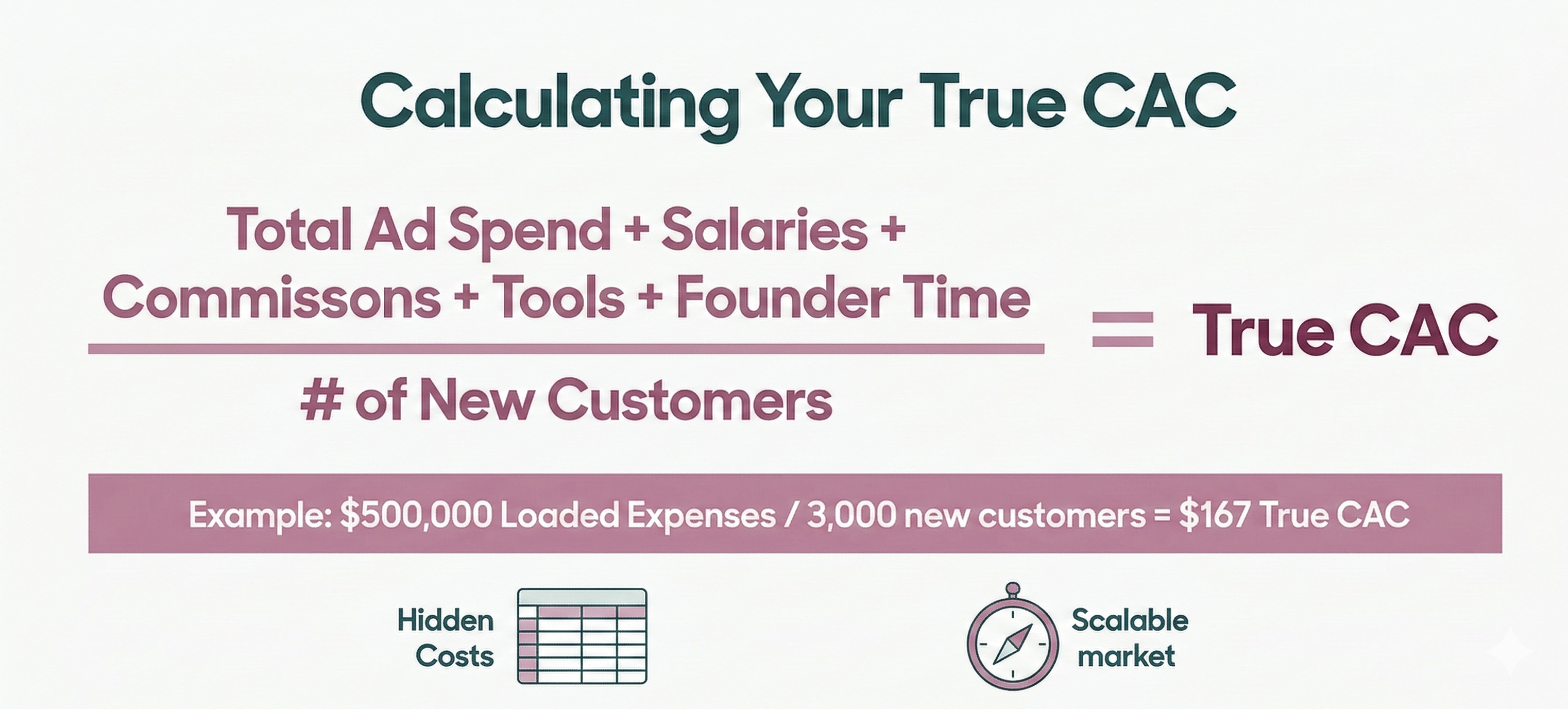
Most teams calculate Customer Acquisition Cost as ad spend / new customers and stop there. A realistic, fully-loaded CAC includes every expense tied to acquisition:
- marketing salaries
- sales commissions
- the software stack used to acquire
- agency fees
- onboarding time
- a portion of founder effort if the founder is closing early deals
Add it all up and the real cost per user is usually much higher than the version on the marketing dashboard. Ignore those inputs and you aren't growing — you are buying users at a loss you haven't measured.
The payback clock
LTV is often a guess, but payback period is a fact — how many months it takes to earn back the money you spent to acquire a customer. The brutal scenario: if your average user leaves after 10 months but it takes 14 months to break even, your business loses money every single day it grows. Growing faster makes the bleeding worse, not better.
The margin of truth
As you grow, support load, infrastructure, and reliability work all rise. If your gross margin model ignores those scaling costs, your profit looks better on paper than it ever does in the bank. Real growth is when the system earns more than it spends — not when outside capital is patching a leaky boat.
Founder time is a hidden cost
In the early stages, founders close deals, hand-hold key accounts, and personally fix onboarding friction. If that effort isn't accounted for somewhere, the business looks more scalable than it is — and the bill comes due the moment you try to hire someone to replace the founder. Looking at growth through unit economics, instead of headline revenue, separates companies building durable leverage from those financing momentum with capital.
6. What VCs actually mean by "scalable growth"
When an investor says "we need to see scalable growth," they're not asking for a chart that goes up and to the right. They're asking a sharper question: can you put a dollar in and get a predictable result out, month after month — or did you just get lucky? They look for three things.

1. Repeatability
Scalability means the growth wasn't an accident. One viral post or one big partnership is not a motion. Investors want a primary acquisition channel that works consistently, with costs that stay roughly steady as you bring in more users. If each additional user gets meaningfully more expensive to find, the business will eventually run out of room.
2. Improvement with age
A healthy startup gets better as it grows. Investors compare your newest cohorts to older ones at the same age: are new users activating faster, going deeper, retaining stronger? If yes, the product is maturing. If new cohorts are weaker, you're probably reaching beyond your real fit — selling to people who don't actually need what you built.
3. Pull
The third signal is pull — growth that happens without you paying for it. Word of mouth. Network effects where the product becomes more useful as more people join. Content that compounds long after the ad spend stops. Pull is what makes a company genuinely valuable, because it means capital is fuel for a fire that's already burning, instead of someone trying to start a fire from scratch with a flamethrower of cash.
7. Five uncomfortable questions every founder should ask
Before you add another channel, hire another growth lead, or raise on the strength of a rising chart — sit with these questions. They are uncomfortable on purpose.
-
If you stopped paid marketing tomorrow, what happens next quarter? Would signups collapse, or would organic demand and referrals continue bringing in users who behave like your current base? The answer reveals whether you are building pull or renting attention.
-
Are your strongest cohorts improving over time? Compare recent cohorts to earlier ones at the same age. If activation, engagement depth, and retention strengthen with each iteration, the product is maturing. If they weaken, growth is stretching beyond real fit.
-
Does retention stabilize at a meaningful level, or keep decaying? A flat curve is good — but only if it flattens at a meaningful percentage. Plateauing at 2% means you found a tiny niche, not a market.
-
Are you solving a painful, urgent problem, or just a convenient one? Urgent problems generate repeat usage and willingness to pay without constant persuasion. Convenient ones lose to whatever is shiny next month.
-
Does growth come from users discovering value on their own, or from your team pushing harder each month? Sustainable companies require less effort per unit of revenue over time, not more.
These questions sting, but they tell you the truth about where you stand and how much room you actually have to grow.
The takeaway
Building in 2026 is faster and cheaper than ever, which means the noise is louder than ever. Most founders don't fail because they need a better tactic or a cleverer ad — they fail because they keep their eyes on the surface metrics (signups, traffic, revenue spikes) and ignore the underlying signals (cohort retention, true CAC, payback period, organic pull). The discipline this guide is pushing toward is simple to state and hard to live: measure what people do after the first day, count every real cost of acquiring them, pick one channel and master it, and treat growth as something you build into the product rather than bolt onto it. Do that, and capital becomes fuel. Skip it, and capital just makes the leak more expensive.
Author
Ruben Dominguez
Continued reading
Keep your momentum
MKT1 Newsletter
100 B2B Startups, 100+ Stats, and 14 Graphs on Web, Social, and Content
This is Part 2 of MKT1's three-part State of B2B Marketing Report. Where Part 1 looked at teams and leadership , Part 2 turns to what marketing teams are actually doing — what their websites look like, how they use social, and what "content fuel" they're producing. Emily Kramer u
Apr 28 · 10m
Lenny's Newsletter (Lenny's Podcast)
Why Half of Product Managers Are in Trouble — Nikhyl Singhal on the AI Reinvention Threshold
Nikhyl Singhal is a serial founder and a former senior product executive at Meta, Google, and Credit Karma . Today he runs The Skip ( skip.show (https://skip.show)), a community for senior product leaders, plus offshoots like Skip Community , Skip Coach , and Skip.help . Lenny de
Apr 27 · 7m

The AI Corner
The AI Agent That Thinks Like Jensen Huang, Elon Musk, and Dario Amodei
Dominguez opens with a claim that is easy to skim past but worth stopping on: the difference between elite founders and everyone else is not raw IQ or speed — it is that each of them has internalized a repeatable mental procedure they run on every important decision. The procedur
Apr 27 · 6m