The VC Corner
Mistral AI's €105M Memo, Enterprise SaaS Defense, and Why Seed Math Broke
Ruben Dominguez
Apr 26, 2026
Mistral AI's €105M Memo, Enterprise SaaS Defense, and Why Seed Math Broke
Source: The VC Corner — Author: Ruben Dominguez — Date: April 26, 2026 — Original article
This is a weekly digest issue of The VC Corner. Instead of one long deep-dive, it stitches together the week's most useful signals for founders and investors: a few sharp insights about how the AI era is rewriting startup economics, fresh reports worth bookmarking, new funds entering the market, VC jobs, and the biggest funding rounds. Below is a teaching summary that pulls out the why behind each item, so a software engineer reading this can walk away with the same mental models someone who read the full issue would have.
Note: this issue is mostly a curated link roundup. Many items are short pointers to longer essays elsewhere. Where the original entry is essentially a one-line teaser, that's what's available — fuller analysis lives in the linked source articles.
1. In-Depth Insights — what changed in the market this week
Enterprise SaaS defense has to be redrawn under AI pressure
For years, the standard SaaS playbook looked like this: build a focused tool that does one job better than a spreadsheet, charge per seat, and let net revenue retention compound. That worked because each tool had a moat made of integration cost — once you bought the seat licenses and wired up your data, ripping it out was painful.
AI broke two pieces of that assumption almost simultaneously:
- Bundling. When the platform vendors (Microsoft, Google, Salesforce, the model labs themselves) ship AI features inside the suite the customer already pays for, a standalone tool that does "the same thing but better" suddenly competes against something that costs zero marginal dollars. The customer doesn't even have to negotiate — it just appears in the Office ribbon.
- Rapid model improvement. A capability that was a defensible product six months ago — say, summarising a contract or drafting a sales email — is now a one-prompt feature. The thing you charged $40/seat/month for collapses into a checkbox.
Together those two forces compressed standalone pricing assumptions in under a year. The takeaway, per the issue: survival is no longer about feature parity. It's about three things working at once — distribution control (owning the channel so the bundled competitor can't reach your buyer first), product depth (workflows so deeply embedded that ripping them out costs more than the savings from the bundle), and tighter alignment between sales and usage (you charge for outcomes that actually show up in the product telemetry, not for seats that may or may not log in).
The mental model: in the pre-AI era your moat was your feature. In the AI era your feature is rented from a model lab; your moat has to be something the model can't generate on demand — distribution, data, or workflow lock-in. (Full essay on The AI Corner)
Prediction markets are shifting on Democratic leadership
Polymarket-style prediction markets are showing rising odds for certain Democratic figures, but the issue's point is epistemic, not political: a rising odds line on a prediction market reflects the confidence of traders willing to put money down, not a consensus of the party or the electorate. High trade volume on the question is itself a signal that uncertainty is high — markets are loud when people disagree, quiet when they don't. Read prediction-market moves as a thermometer of trader belief, not as a forecast of outcomes. (Polymarket pointer)
Seed math broke, so portfolio strategy has to change
This is the most important item in the issue for anyone thinking about early-stage venture. The traditional seed math worked roughly like this:
- Write 30 small checks at low entry prices.
- Most go to zero. A few return 1–3x. One returns 50–100x and pays for the whole fund.
- Wide diversification is the strategy because the upside per winner is enormous.
What broke: entry prices at seed have compressed upside across the board. When seed valuations climb (because every fund is chasing the same AI deals, because angels are bidding rounds up, because founders price off the last comparable round), the same eventual exit returns less of a multiple. A company that exits at $1B used to be a 100x at a $10M post-money entry; at a $40M post-money entry it's a 25x. Across a portfolio of 30 checks, that compression is the difference between a top-decile fund and a flat one.
The strategic response: fewer companies, bigger checks, more discipline on entry price. Concentrate into companies where you have conviction on both quality (the company will actually compound) and price (you got in at a level where the math still works). Diversification is no longer a free lunch — it's a way to dilute your few real winners. (Lucas Vaz post)
Founders fail from lack of clarity, not lack of effort
Most struggling teams aren't lazy. They're working extremely hard on something they can't crisply describe. The diagnostic test: can the founder, in one sentence, say what they're building, for whom, and how they'll know it's working? If they can't, no amount of effort will produce traction — they'll just generate motion.
The fix is tight feedback loops: small, cheap tests with clear pass/fail criteria, plus retention signals (do the people who tried it come back?) rather than vanity metrics (signups, downloads, press). Retention is the only number that separates "people are curious" from "people need this." (Founders Inc post)
GPT-5.5 launch — benchmarks vs. Claude Opus 4.7
OpenAI shipped GPT-5.5 with measurable gains over the previous generation in coding and reasoning benchmarks. The honest read on the numbers, per the issue: gains are real but uneven across applied benchmarks — meaning the model is meaningfully better at some real-world tasks and roughly the same at others. The practical lesson for engineering teams: leaderboard position is the wrong selection criterion. What matters is reliability inside your specific workflow — does the model behave consistently on your actual prompts, your tools, your data, your latency budget? Pick by harness performance, not by headline. (LinkedIn post)
Mistral AI's €105M seed memo — six employees, four weeks in, no customers
The headline number is jarring: Mistral raised €105M at seed. Six employees. Four weeks of company existence. Zero customers, zero revenue, zero shipped product. The question every founder should ask is how is that even possible?
The answer is not "they're famous researchers" (that helps but doesn't explain a nine-figure seed). It's the memo. A focused written document that aligned investors around the strategy before there was any technical execution to point to. The strategic claim was specific: open-source distribution wasn't framed as a goodwill gesture or a community-building tactic — it was framed as a control-layer strategy. Open weights become the substrate that enterprises and developers integrate into; whoever owns the most-integrated open layer captures the gravity of the ecosystem, even if individual model capabilities aren't ahead of closed competitors.
Why investors paid for that: in a market where capability advantages are short-lived (see the GPT-5.5 item above), distribution and ecosystem position outlast model leads. A memo that articulates this clearly is the de-risking — there's nothing to demo, but there's everything to evaluate.
The lesson for founders raising in capital-intensive categories: when you can't show traction, the substitute is a thesis sharp enough that an investor can act on it without traction. (Memo breakdown on The AI Corner)
The AI deployment gap is the real bottleneck
Jason Lemkin's observation, summarized: AI tools are landing differently across the customer size spectrum. Large enterprises get forward-deployed engineers (FDEs) — actual humans from the vendor sitting in the customer's environment, configuring the system, training users, building the integrations. Smaller teams get a self-serve signup flow and a docs page.
The result: enterprise customers convert and expand because someone made the tool actually work in their context. Self-serve customers churn because "set up a working AI workflow" is harder than the marketing implies. The competitive insight: at this stage of the AI cycle, structured onboarding with direct support drives conversion far more than better models alone. The model is increasingly a commodity; the deployment is the product. Vendors who treat onboarding as a cost center will lose to vendors who treat it as the thing they sell. (SaaStr article)
2. Interesting Reports
- HSBC Innovation Banking VC Term Sheet Guide 2026 — a sector-by-sector breakdown of where term-sheet flexibility actually exists in 2026, including liquidation preferences, anti-dilution mechanics, and downside protection. Useful because it shows the negotiation range per sector, not just the headline median terms. (LinkedIn pointer).
- Carta — 2026 PE Executive Equity Report. How private equity allocates ownership when recruiting senior operators. Covers grant sizing, vesting logic, and how equity structures differ across entity types. (Carta)
- DealRoom — Victorian Startup Growth Report 2025. Maps capital flow, valuation shifts, and exit timing across Victoria (Australia) from seed to late stage. Useful as a regional case study of where value concentrates across the lifecycle. (DealRoom)
3. Recently Launched Funds
- Sideline Group — closed Fund I at $155M, investing across sports, media, and entertainment startups. Thesis: convergence of content, fandom, and tech-driven platforms.
- Mighty Capital — Fund III at $91M, product-led startups with strong PMF and scalable growth engines.
- Newfund (Heka Fund) — €60M for next-gen European tech: SaaS, fintech, digital infrastructure.
- Passion Capital — Fund IV at $55M, early-stage European founders, day-zero focus.
- Firstminute VC — €50M for AI-driven gaming and entertainment startups.
- Homegrown Ventures — Fund I at $22.8M, early-stage emerging founders.
4. Hottest Deals of the Week
- Vertical Bridge — $1.5B strategic equity investment from KKR (telecom infrastructure).
- Blue Energy — $380M for next-gen clean energy and infrastructure deployment.
- Wasabi Technologies — $250M credit facility to scale cloud storage operations.
- Reliable Robotics — $160M for autonomous aviation and certification.
- Pudu Robotics — ~$150M at a $1.5B valuation, service robotics expansion.
- Ray Therapeutics — $125M Series B, neurological gene therapy pipeline.
- Omni — $120M Series C at a $1.5B valuation, AI-driven commerce.
- Verda — $117M for sustainability and climate infrastructure.
- Tortugas Neuroscience — $106M combined seed + Series A, brain/neurotech research.
- AcuityMD — $80M Series C, medical device analytics.
- Cloudsmith — $72M Series C, software artifact management / DevOps.
- Digantara — $50M Series B, space situational awareness.
- Tava Health — $40M Series C, mental health and therapy access.
- Neocognition — $40M seed, AI-driven cognitive / neuroscience tech.
- Syenta — $26M Series A, enterprise AI / data intelligence.
5. VC Jobs (selected)
- Inception Capital — VC Internship (Remote)
- Cross Creek — VC Analyst (Salt Lake City)
- Penny Jar Capital — VC Principal (San Francisco)
- Campus Fund — VC Investor (Remote)
- Betaworks — VC Associate (NYC)
- Forbion — VC Associate (Boston)
- Cigna Ventures — VC Associate (Remote)
- SK hynix — VC Analyst (San Jose)
- Sofinnova Investments — VC Internship (Remote)
- Samsung Next — VC Investor (Mountain View)
The through-line
Three of this week's items rhyme: SaaS defense in the AI era, broken seed math, and the Mistral memo. The common thread is that the old playbook — diversify across many small bets on feature-differentiated products — has weaker payoff than it used to, because both the moats (features) and the entry prices (seed valuations) have compressed at the same time. The replacement playbook is concentration: fewer, sharper bets in companies with genuine distribution or workflow control, and the willingness to underwrite them on the strength of a thesis rather than on traction proof. The Mistral memo is the case study; the SaaS defense piece is the diagnosis; the seed-math item is the portfolio-construction consequence.
Author
Ruben Dominguez
Continued reading
Keep your momentum
MKT1 Newsletter
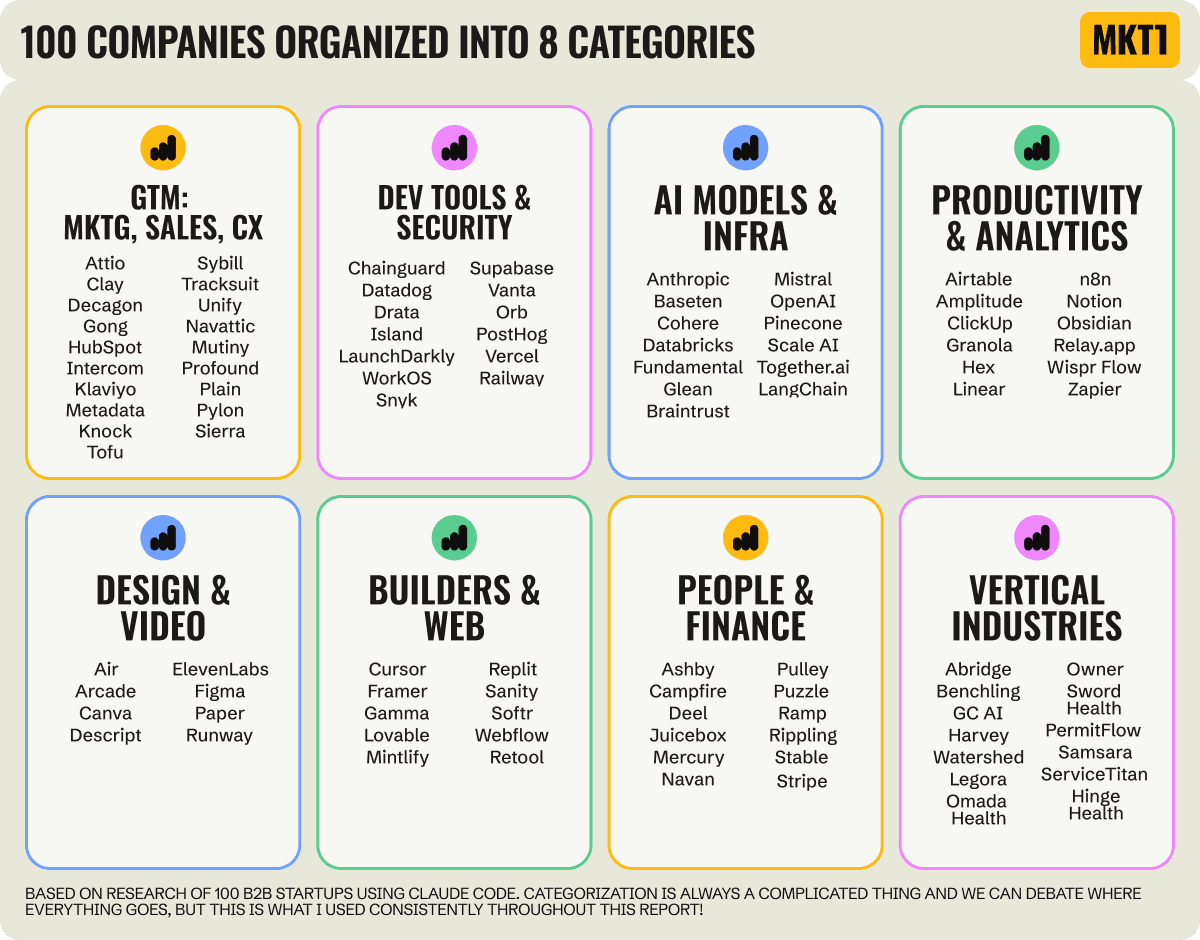
100 B2B Startups, 100+ Stats, and 14 Graphs on Web, Social, and Content
This is Part 2 of MKT1's three-part State of B2B Marketing Report. Where Part 1 looked at teams and leadership , Part 2 turns to what marketing teams are actually doing — what their websites look like, how they use social, and what "content fuel" they're producing. Emily Kramer u
Apr 28 · 10m
Lenny's Newsletter (Lenny's Podcast)
Why Half of Product Managers Are in Trouble — Nikhyl Singhal on the AI Reinvention Threshold
Nikhyl Singhal is a serial founder and a former senior product executive at Meta, Google, and Credit Karma . Today he runs The Skip ( skip.show (https://skip.show)), a community for senior product leaders, plus offshoots like Skip Community , Skip Coach , and Skip.help . Lenny de
Apr 27 · 7m

The AI Corner
The AI Agent That Thinks Like Jensen Huang, Elon Musk, and Dario Amodei
Dominguez opens with a claim that is easy to skim past but worth stopping on: the difference between elite founders and everyone else is not raw IQ or speed — it is that each of them has internalized a repeatable mental procedure they run on every important decision. The procedur
Apr 27 · 6m