The AI Corner
43 backlinks every founder should chase before AI Overviews eat their traffic
Ruben Dominguez
Apr 27, 2026
43 backlinks every founder should chase before AI Overviews eat their traffic
Source: The AI Corner · Author: Ruben Dominguez · Date: April 27, 2026 · Original article
Note: This post is mostly paywalled. The summary below covers the free preview, which lays out the why (the data and the structural shift) and the what's inside (the table of contents of the paid playbook). The 43 specific URLs themselves sit behind the paywall.
The shift this guide is built around
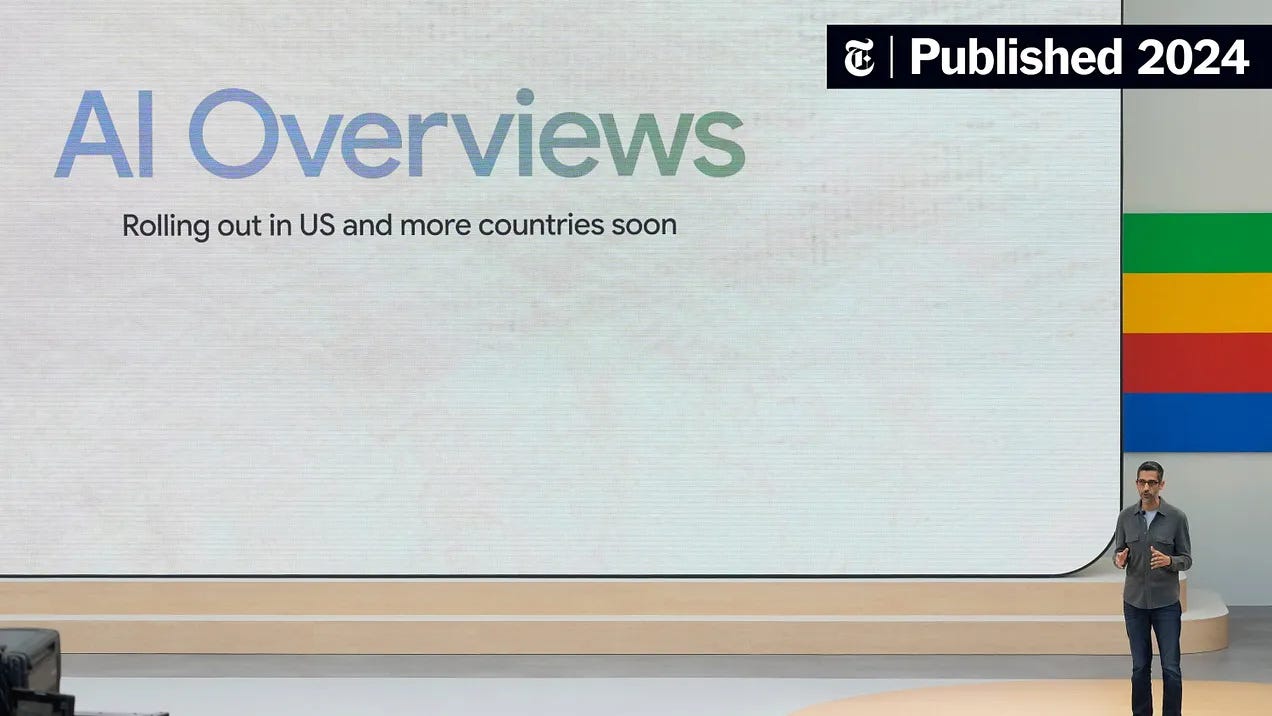
In May 2024, Google launched AI Overviews in U.S. search — those AI-generated answers that now sit on top of the blue links. Within roughly 18 months, organic traffic to content publishers collapsed harder than anyone in SEO had modeled.
A few concrete fallout markers the author cites:
- Chegg sued Google directly, naming AI Overviews as the cause of its stock falling under $1.
- Stack Overflow cut 28% of staff as ChatGPT absorbed technical Q&A traffic that used to flow to it from Google.
- Hundreds of mid-tier SaaS companies saw their search-driven pipeline disappear quarter-over-quarter, and most assumed it was a temporary algorithm shake-up rather than a permanent rewiring.
The "structural vs. cyclical" distinction matters, because the fix is different. A cyclical dip means wait it out; a structural shift means change where you show up.
The data that says it's structural
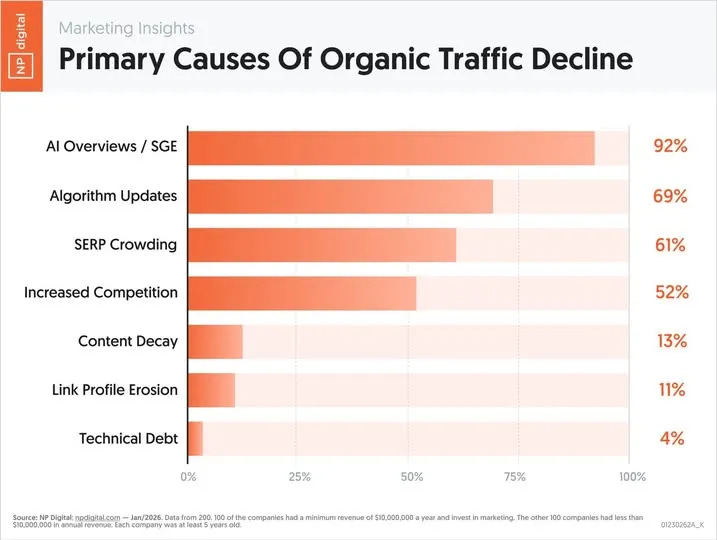
NP Digital's January 2026 study of 200 companies (split between $10M+/yr marketing budgets and smaller spenders) ranked the causes of organic traffic decline by attribution percentage:
- AI Overviews / SGE — 92% (the dominant cause)
- Algorithm updates — 69%
- SERP crowding — 61%
- Increased competition — 52%
- Content decay — 13%
- Link profile erosion — 11%
- Technical debt — 4%
The point: AI Overviews aren't one factor among many. They are roughly the entire story.
Where the audience went
Buyers, founders, and operators now research products inside ChatGPT, Perplexity, Claude, and Gemini. That means a new SEO-shaped problem has appeared next to the old one: getting cited by LLMs. The industry calls this AEO (Answer Engine Optimization) and GEO (Generative Engine Optimization) — basically, "rank inside the AI's answer" instead of "rank inside Google's results."
Three studies the author leans on:
- Profound analyzed 680 million LLM citations and found models pull from a surprisingly narrow set of platforms — Wikipedia, Reddit, Stack Exchange, G2, Capterra, YouTube, LinkedIn — far more than from the open web.
- First Page Sage ran a 36,000-query buying-intent study and found G2 is the single most-cited domain for B2B software questions inside ChatGPT.
- ConvertMate's 2026 GEO benchmark found startups with a Wikidata presence get cited 2.8x more by AI assistants than those without.
The 20 most-cited domains by LLMs (2026)
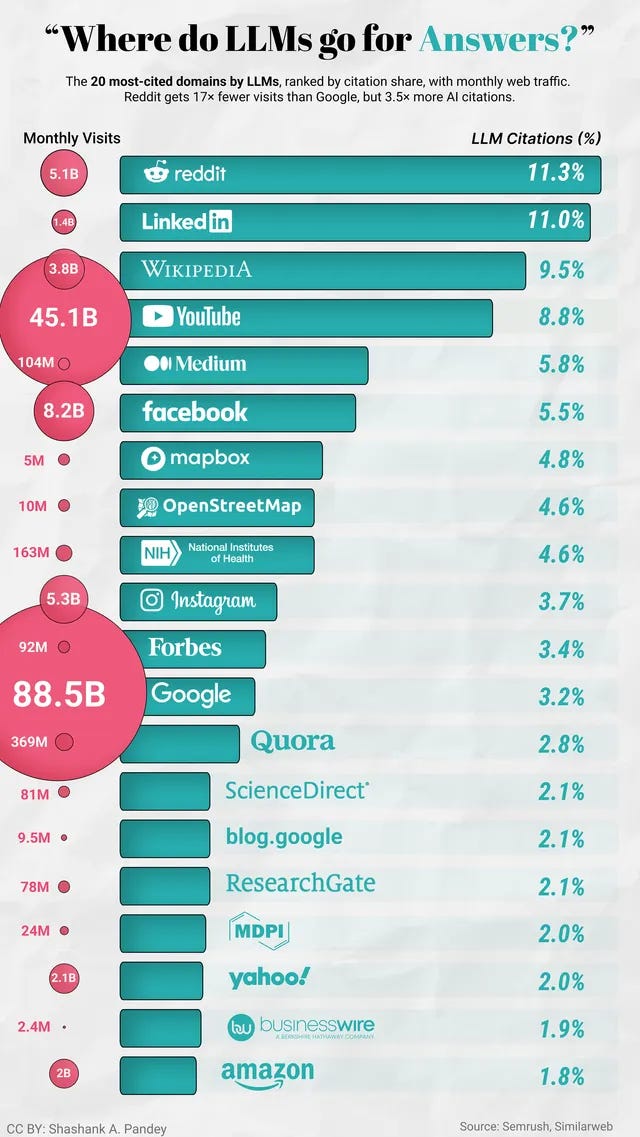
Shashank A. Pandey ranked the top 20 by LLM citation share (using Semrush + Similarweb data):
| Rank | Domain | LLM citation share | Monthly visits |
|---|---|---|---|
| 1 | 11.3% | 5.1B | |
| 2 | 11.0% | 1.4B | |
| 3 | Wikipedia | 9.5% | 3.8B |
| 4 | YouTube | 8.8% | 45.1B |
| 5 | Medium | 5.8% | — |
| 6 | 5.5% | 8.2B | |
| 7 | Mapbox | 4.8% | — |
| 8 | OpenStreetMap | 4.6% | — |
| 9 | NIH | 4.6% | — |
| 10 | 3.7% | 5.3B | |
| 11 | Forbes | 3.4% | — |
| 12 | 3.2% | 88.5B | |
| 13 | Quora | 2.8% | — |
| 14 | ScienceDirect | 2.1% | — |
| 15 | blog.google | 2.1% | — |
| 16 | ResearchGate | 2.1% | — |
| 17 | MDPI | 2.0% | — |
| 18 | Yahoo | 2.0% | 2.1B |
| 19 | BusinessWire | 1.9% | — |
| 20 | Amazon | 1.8% | 2B |
The headline statistic: Reddit gets ~17x fewer visits than Google but generates ~3.5x more AI citations. Translation: LLM citation share and traditional Google traffic are uncorrelated games. The platforms that win one barely overlap with the platforms that win the other. Optimizing only for the old game leaves the new one untouched.
What this means for founder strategy
The author's framing: backlinks still matter for Google rankings — that's not going away soon. But the AEO/GEO citation graph now drives a meaningful slice of actual buyer discovery, and the surfaces that influence AI citations look almost nothing like the link-building checklists most founder SEO guides hand out. So you need both lists, and most founders only have one.
The full guide claims to give you the second list — 43 verified backlink and citation sources for 2026, with:
- Every URL checked
- Every Domain Rating triangulated against Ahrefs's September 2025 algorithm update
- Every dofollow vs. nofollow distinction flagged. (Quick translation: a dofollow link passes SEO authority — Google counts it as a vote. A nofollow link does not pass authority but still drives traffic and brand signals. You want to know which is which so you don't burn outreach effort on links that don't move the metric you care about.)
It is positioned for founders who would rather execute themselves than pay an SEO agency a six-month retainer for a less complete list.
What the paid playbook contains (table of contents)
The free preview lists the sections of the paywalled guide:
- 14 AEO/GEO sources LLMs actually cite — with citation evidence, training-corpus context, and the submission URL for each.
- 23 AI tool directories accepting submissions in 2026, ranked by Domain Rating, dofollow status, and submission cost.
- A guest post matrix covering which AI publications accept editorial submissions, which are paid-only, and which actually pay you to write for them.
- A newsletter sponsorship tier including TLDR AI, The Rundown, Superhuman, The Neuron, Ben's Bites, and Mindstream — with audience sizes and submission flows.
- 18 high-DR generalist sources nobody else lists — design galleries, startup launchpads, dev communities, plus the premium guest-post tier at Fast Company, Inc, and TechRepublic.
- A dofollow vs. nofollow audit so you can see where the real SEO juice lives and where you're just spending time.
- The 7 directories to submit to first if you only have one hour this week.
- The 3 structural priorities the author argues beat any individual backlink decision in 2026.
The pitch closes with a 7-day free trial and a 50%-off-forever offer for first subscribers.
What a beginner should take away
Even without the 43 URLs, the free portion teaches the most important thing — the mental model:
- The discovery layer split. There are now two parallel discovery layers: Google search (still big, but shrinking from the top via AI Overviews) and LLM chat (ChatGPT/Perplexity/Claude/Gemini). They reward different surfaces.
- LLMs cite a narrow corpus. They don't crawl "the open web" the way Google does — they over-index on a small set of high-trust, structured sources (Wikipedia, Reddit, Stack Exchange, G2, Capterra, YouTube, LinkedIn). If your brand isn't represented there, you are largely invisible to the AI answer layer.
- Citation share ≠ traffic share. Reddit's 17x-less-traffic / 3.5x-more-citations stat is the cleanest proof. You can't read Similarweb rankings and infer LLM influence; you have to look at citation data directly.
- Two backlink strategies, not one. Old playbook: chase DR for Google rankings. New playbook layered on top: get listed/mentioned/cited on the specific platforms LLMs pull from, register on Wikidata (the 2.8x multiplier), and treat AI directories as a real channel.
- Dofollow vs. nofollow is still the right lens for prioritizing SEO effort, but for AEO/GEO the question shifts to "does this source feed the LLM training/retrieval corpus?" — a different filter entirely.
If you only do one thing after reading: audit whether your company has a Wikidata entry, a presence on the top-5 LLM-cited domains (Reddit, LinkedIn, Wikipedia, YouTube, Medium), and review listings on G2/Capterra if you sell B2B software. Those moves alone match most of what the data in the free preview points at.
Author
Ruben Dominguez
Continued reading
Keep your momentum
MKT1 Newsletter
100 B2B Startups, 100+ Stats, and 14 Graphs on Web, Social, and Content
This is Part 2 of MKT1's three-part State of B2B Marketing Report. Where Part 1 looked at teams and leadership , Part 2 turns to what marketing teams are actually doing — what their websites look like, how they use social, and what "content fuel" they're producing. Emily Kramer u
Apr 28 · 10m
Lenny's Newsletter (Lenny's Podcast)
Why Half of Product Managers Are in Trouble — Nikhyl Singhal on the AI Reinvention Threshold
Nikhyl Singhal is a serial founder and a former senior product executive at Meta, Google, and Credit Karma . Today he runs The Skip ( skip.show (https://skip.show)), a community for senior product leaders, plus offshoots like Skip Community , Skip Coach , and Skip.help . Lenny de
Apr 27 · 7m
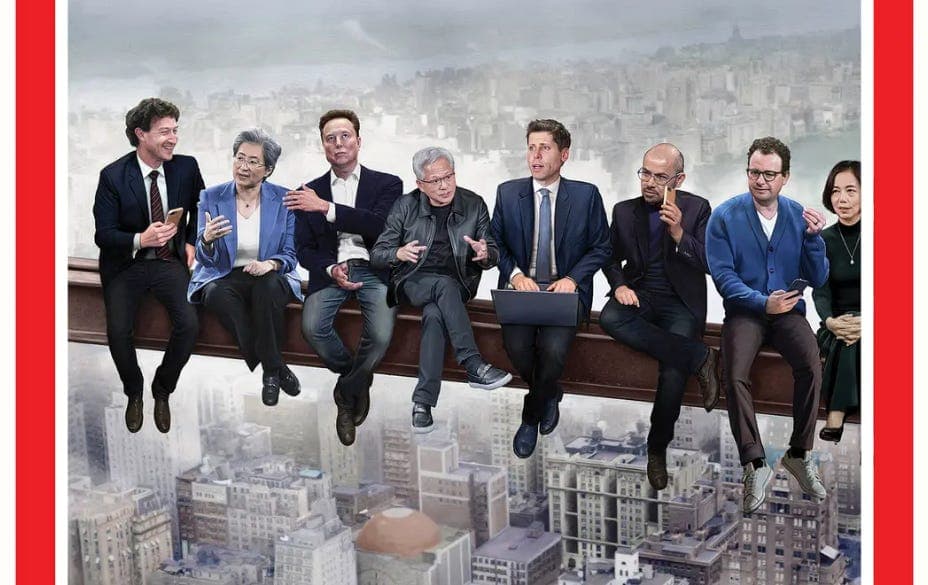
The AI Corner
The AI Agent That Thinks Like Jensen Huang, Elon Musk, and Dario Amodei
Dominguez opens with a claim that is easy to skim past but worth stopping on: the difference between elite founders and everyone else is not raw IQ or speed — it is that each of them has internalized a repeatable mental procedure they run on every important decision. The procedur
Apr 27 · 6m