Engineering Leadership
The Engineering Career Barbell: Why "Middle of the Road" Is the Riskiest Place to Be
Gregor Ojstersek
Apr 16, 2026
The Engineering Career Barbell: Why "Middle of the Road" Is the Riskiest Place to Be
Source: Engineering Leadership · Author: Gregor Ojstersek · Date: 2026-04-16 · Original article
Note: Most of this article is paywalled. This summary covers the freely accessible portion (the setup and thesis), plus the structure of what's behind the paywall.
The Big Idea: A Barbell, Not a Bell Curve
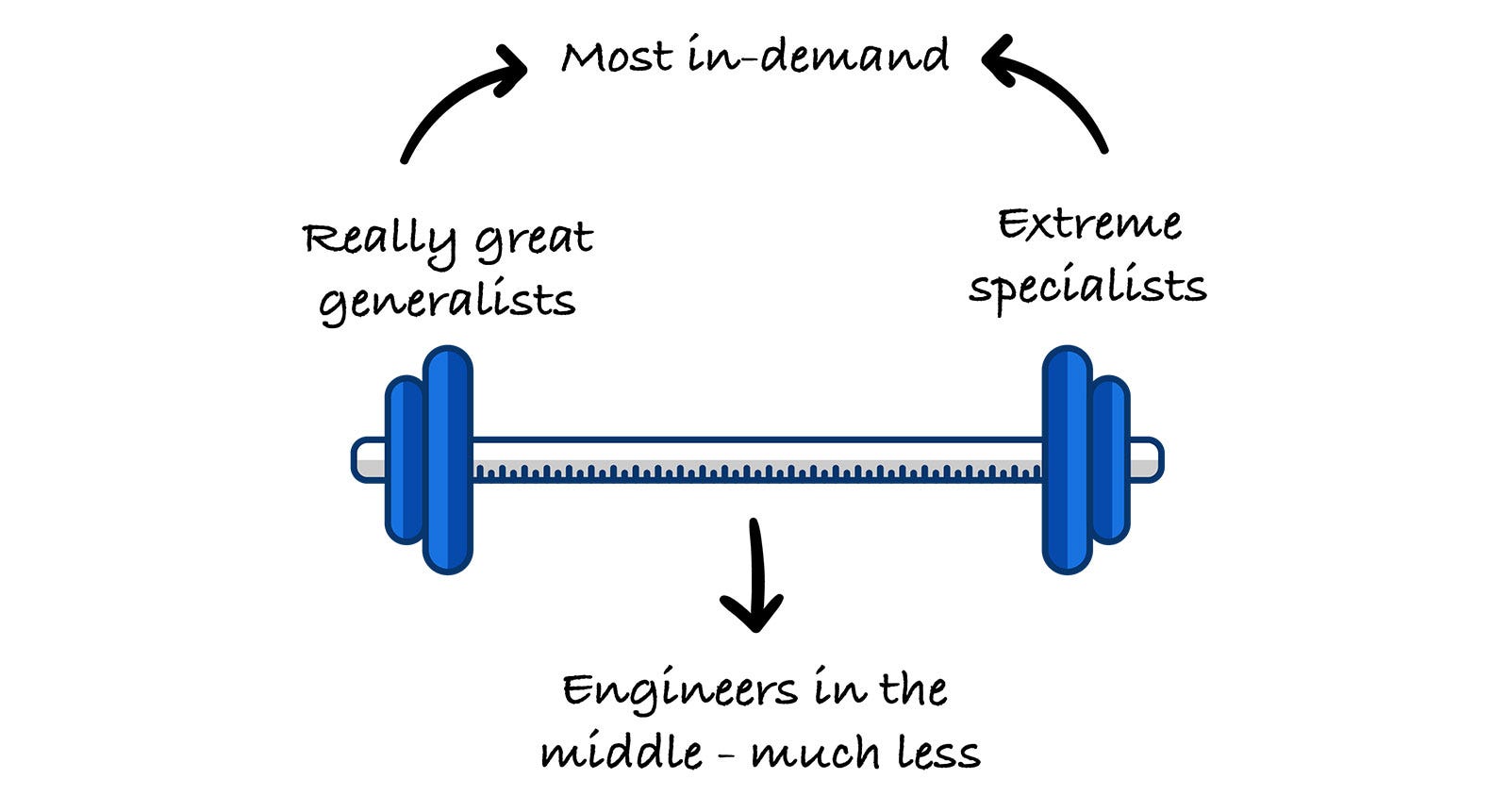
Imagine a barbell — heavy weights on each end, a thin bar in the middle. Gregor argues that engineering hiring now looks exactly like that. The two "weights" — the spots where demand is concentrated — are:
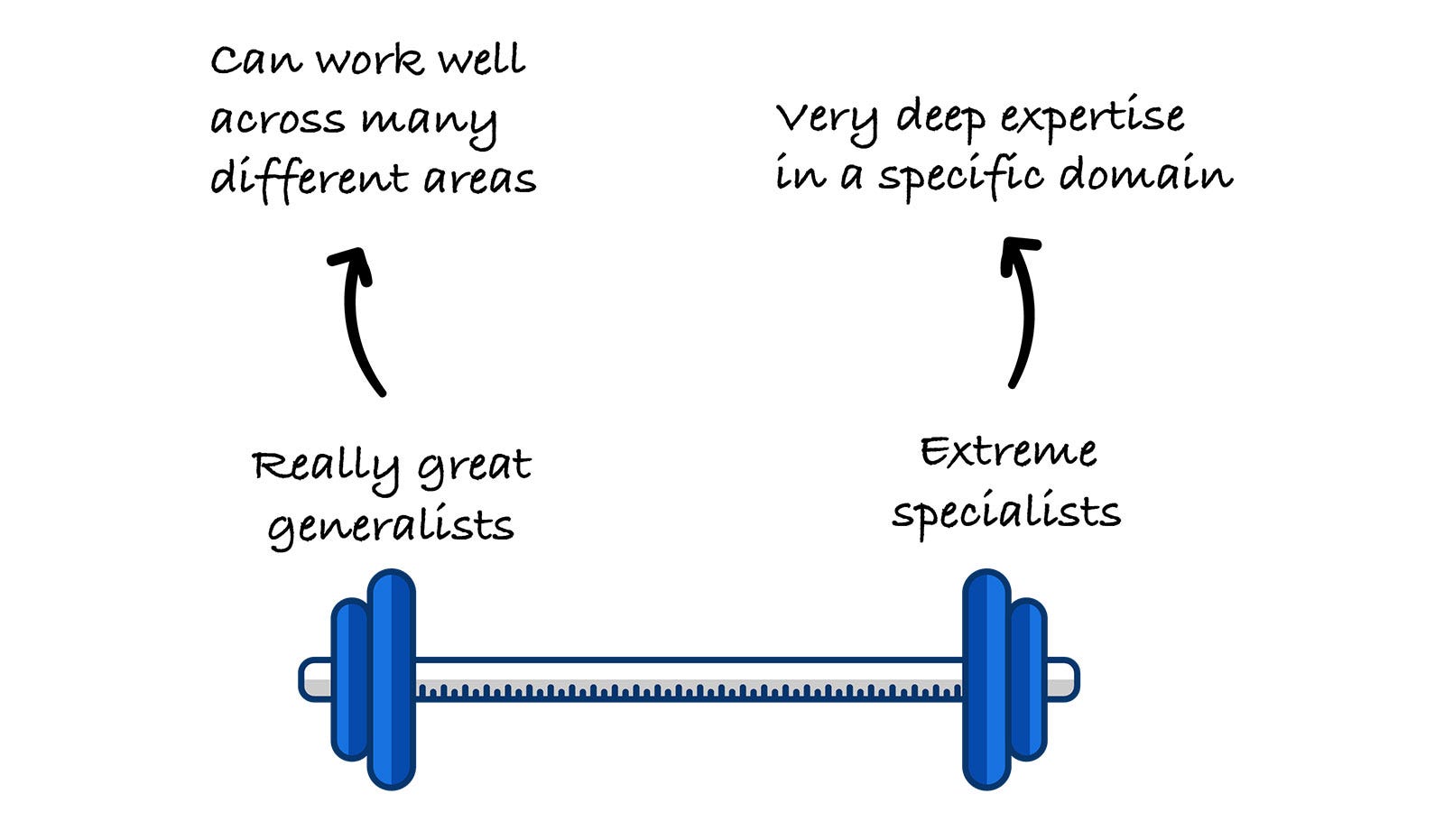
- Great generalists — engineers who can build and ship a feature end-to-end across mobile, frontend, backend, infra, and even talk to users.
- Extreme specialists — engineers with rare, hard-to-replace expertise in one specific technology or domain.
The thin bar in the middle? That's the engineer who is "pretty good at a few things but not great at any of them." Those people, he argues, will get fewer and fewer opportunities. Not because they're bad — but because companies can't easily articulate the unique value they bring. They don't have the "superpower" of broad shipping ability, and they don't have the "superpower" of deep, irreplaceable knowledge.
The takeaway, stated bluntly: pick a side. Drift in the middle and you'll be the easiest person to pass over.
What Gregor Is Seeing on the Ground in San Francisco
Gregor wrote this while spending a week in SF, attending Salesforce's TDX conference and meeting with companies. A few observations he uses to back up the thesis:
- AI is the only conversation. Streets, cafes, screens — every discussion circles around AI agents, MCP (Model Context Protocol), "vibe coding," and AI adoption. This matters because it's the force reshaping what kinds of engineers companies need.
- The role of "engineer" is expanding. What used to be a PM's job — talking to users, shaping the feature, deciding what to build — is increasingly landing on the engineer's plate. The phrase he keeps hearing is "product-minded engineer." That's another label for the great-generalist archetype.
- Specialists still matter, just differently. Alongside the product-minded generalists, companies still want a small number of people with deep, often hard-won expertise — sometimes in AI, sometimes in a specific tech, sometimes just "battle scars" in a domain (e.g., payments, distributed systems, real-time video).
These are the two ends of the barbell.
The Role of Engineers Is Changing — Especially at Smaller Companies
The shift is sharpest at startups and mid-size companies. Two concrete signals:
- The PM-to-engineer ratio is shrinking — sometimes to zero. Gregor cites a conversation with Vrushank Vyas (GTM at PortKey): the company has ~24 engineers and 0 product managers. Engineers own product thinking themselves. That's only viable if those engineers are generalists who can talk to users and ship across the stack.
- There are more engineering roles open, not fewer — but they're skewed. The majority of openings he sees are for great generalists, with a minority for extreme specialists. Average engineers in the middle are not what's being hired for.
Concrete example: how OpenAI staffs ChatGPT
Gregor relays a conversation with Sulman Choudhry, Head of Engineering for ChatGPT at OpenAI. Sulman describes their hiring as the barbell made literal:
- One side: extreme generalists. Engineers who can move across mobile, frontend, backend — not the deepest in any one area, but capable enough across all of them to build and ship products quickly.
- Other side: extreme specialists. People with very deep expertise and many years in a single domain. The vivid example: their real-time communication specialist is the person who wrote the WebRTC standard. Around him are extreme generalists.
The reason this mix works: the specialist supplies depth that no generalist could replicate, while the generalists move fast across problems. And — importantly — the specialist becomes a teacher. The combination naturally produces a strong mentorship and learning culture, because the specialist has unique knowledge to transfer and the generalists have the breadth to apply it.
This is the model Gregor is predicting will spread.
Why Big Companies Are Slower — but Heading the Same Way
Large companies don't reorganize quickly. Process, headcount planning, and existing role definitions all slow them down. But Gregor's prediction: eventually every company gets here. The economic logic is the same — generalists give you shipping speed and product ownership, specialists give you depth that's hard to copy. People in the middle deliver less unique value than either, so over time the middle gets squeezed out of opportunities, even at slow-moving enterprises.
His blunt practical advice that closes the free portion: you should pick a direction. You can switch later — generalist today, specialist in five years, or vice versa — but you have to choose and invest in it. Drifting is the worst outcome.
What's Behind the Paywall
The free portion ends here. The remainder of the article (paid subscribers only) is structured as:
- Should You Become a Great Generalist or Extreme Specialist? — Gregor's framework for self-assessment.
- Skills that Make a Great Generalist or Extreme Specialist — the concrete capabilities each path requires.
- With Specialists, the Focus Is a Lot More on a Deep Understanding of a Relevant Topic — what "depth" actually means in practice.
- My Recommendation on Which Path to Take — Gregor's personal guidance.
- Last Words.
Takeaways for an Engineer Reading This
Even from just the free portion, there are several practical things to internalize:
- The hiring market is bimodal, not normally distributed. Plan your career as if employers are sorting candidates into two buckets, not ranking them on a single scale.
- "Product-minded engineer" is the new generalist baseline. If you want to play that side, invest in talking to users, shaping features, and shipping across the stack — not just writing code to spec.
- Specialization needs to be extreme to count. "I know React well" isn't a specialization in this framework. "I wrote the WebRTC standard" is. Aim for depth that's genuinely rare.
- Mentorship is part of the specialist's value. Deep expertise pays off doubly when paired with generalists who learn from you.
- AI is accelerating the squeeze on the middle. As AI handles more average-quality coding, the marginal value of an "average engineer in the middle" drops fastest. Both ends of the barbell — broad shippers and deep experts — are harder for AI to replace.
Author
Gregor Ojstersek
Continued reading
Keep your momentum
MKT1 Newsletter
100 B2B Startups, 100+ Stats, and 14 Graphs on Web, Social, and Content
This is Part 2 of MKT1's three-part State of B2B Marketing Report. Where Part 1 looked at teams and leadership , Part 2 turns to what marketing teams are actually doing — what their websites look like, how they use social, and what "content fuel" they're producing. Emily Kramer u
Apr 28 · 10m
Lenny's Newsletter (Lenny's Podcast)
Why Half of Product Managers Are in Trouble — Nikhyl Singhal on the AI Reinvention Threshold
Nikhyl Singhal is a serial founder and a former senior product executive at Meta, Google, and Credit Karma . Today he runs The Skip ( skip.show (https://skip.show)), a community for senior product leaders, plus offshoots like Skip Community , Skip Coach , and Skip.help . Lenny de
Apr 27 · 7m

The AI Corner
The AI Agent That Thinks Like Jensen Huang, Elon Musk, and Dario Amodei
Dominguez opens with a claim that is easy to skim past but worth stopping on: the difference between elite founders and everyone else is not raw IQ or speed — it is that each of them has internalized a repeatable mental procedure they run on every important decision. The procedur
Apr 27 · 6m