The VC Corner
How to Actually Move to San Francisco and Build a Startup: The Complete Founder Guide
Ruben Dominguez
Apr 27, 2026
How to Actually Move to San Francisco and Build a Startup: The Complete Founder Guide
Source: The VC Corner · Author: Ruben Dominguez · Date: Apr 16, 2026 · Original article
 The density of talent, capital, and ambition all in one place.
The framing: SF in 2026 is neither dead nor a utopia
Two loud narratives clash online: "San Francisco is dead" and "SF is a magical builders' utopia." Anyone actually on the ground in 2026 knows the truth sits in between. SF is rough, highly transactional, and moves faster than you can blink — but it still works. Every investor, operator, and potential co-founder you might need is packed into a few square miles. Moving here compresses time: you stumble into the right conversations, find talent at a coffee shop, and get brutally honest feedback before you ask for it.
The decision to move, however, is no longer the default it once was. Remote-first infra is real, rents (while still high) have softened, and many founders have left. So the move has to be a deliberate, specific bet — and this guide walks through exactly when that bet pays off and how to execute it.
1. Why San Francisco still wins for early-stage founders
The case for SF isn't the city's brand. It's the speed at which things move when the right people live within walking distance of each other. Most early-stage outcomes are shaped by a handful of conversations, and in SF those conversations happen earlier and more often. You might meet someone building a layer above your product and within days be pulled into a network that would have taken months to access elsewhere.
The compounding network effect. Being around so many builders creates momentum that finds you instead of you having to engineer it. Someone may already know your name before you reach out. Introductions happen without much effort. In other cities you have to manufacture these moments deliberately; in SF they're a side effect of just showing up.
Patience for messy ideas. Even in 2026, the local scene retains a unique tolerance for the rough early stages of an idea. In most markets you're pushed hard for traction and revenue before anyone pulls out a checkbook. In SF the bet is on how fast you learn and adapt — investors back vision when the data is still thin.
Proximity to the frontier. The talent layer matters as much as the capital. The people working closest to new AI models and infrastructure are concentrated in SF and surprisingly accessible — you bump into them at events and shared workspaces, which dramatically shortens the time it takes to find the right people to build with.
 Early days, small team. The San Francisco way.
None of this cancels out the downsides — cost of living is high, remote work is viable for many. But for founders still figuring things out, where speed beats efficiency, proximity is a massive advantage. There's a more intangible piece too: you're surrounded by people chasing goals that would seem absurd anywhere else, and over time that energy resets your own expectations.
2. Picking your neighborhood is a strategic decision
Where you live in SF affects your company more than founders expect — not because of rent or commute, but because of proximity. The people you run into, the events you can walk to, and the conversations that happen by default all add up. Your neighborhood becomes your network.
The neighborhoods, decoded
- SoMa — the default first stop for founders who want to be in the middle of everything. Walking distance to shared offices, casual dinners, and a constant flow of people obsessed with their own early ideas. It can feel like everyone's there to do business — and that's exactly why it works. Shared housing typically runs $1,500–$2,500/month, less if you pile in with roommates.
- The Mission — a different mix: more second-time founders, more creative energy, less structured.
- Hayes Valley — sits between SoMa and Mission. Calmer pace, higher quality of life, access still holds. Good for founders who want SoMa proximity without living inside it.
- Dogpatch and Potrero Hill — increasingly relevant, especially for YC-adjacent founders. Clusters form here. Less about random collisions, more about consistent proximity to the same group day after day.
- Marina and Fort Mason — operators, experienced founders, some investors, but the energy leans toward established networks rather than early-stage building.
 Rent is high, but so is the speed of opportunity.
The market is more flexible than founders assume
Cost of living is still high, but more flexible than it used to be. Rents have softened, landlords expect negotiation, and short-term setups are easier to secure. Founders who treat pricing as fixed often overpay.
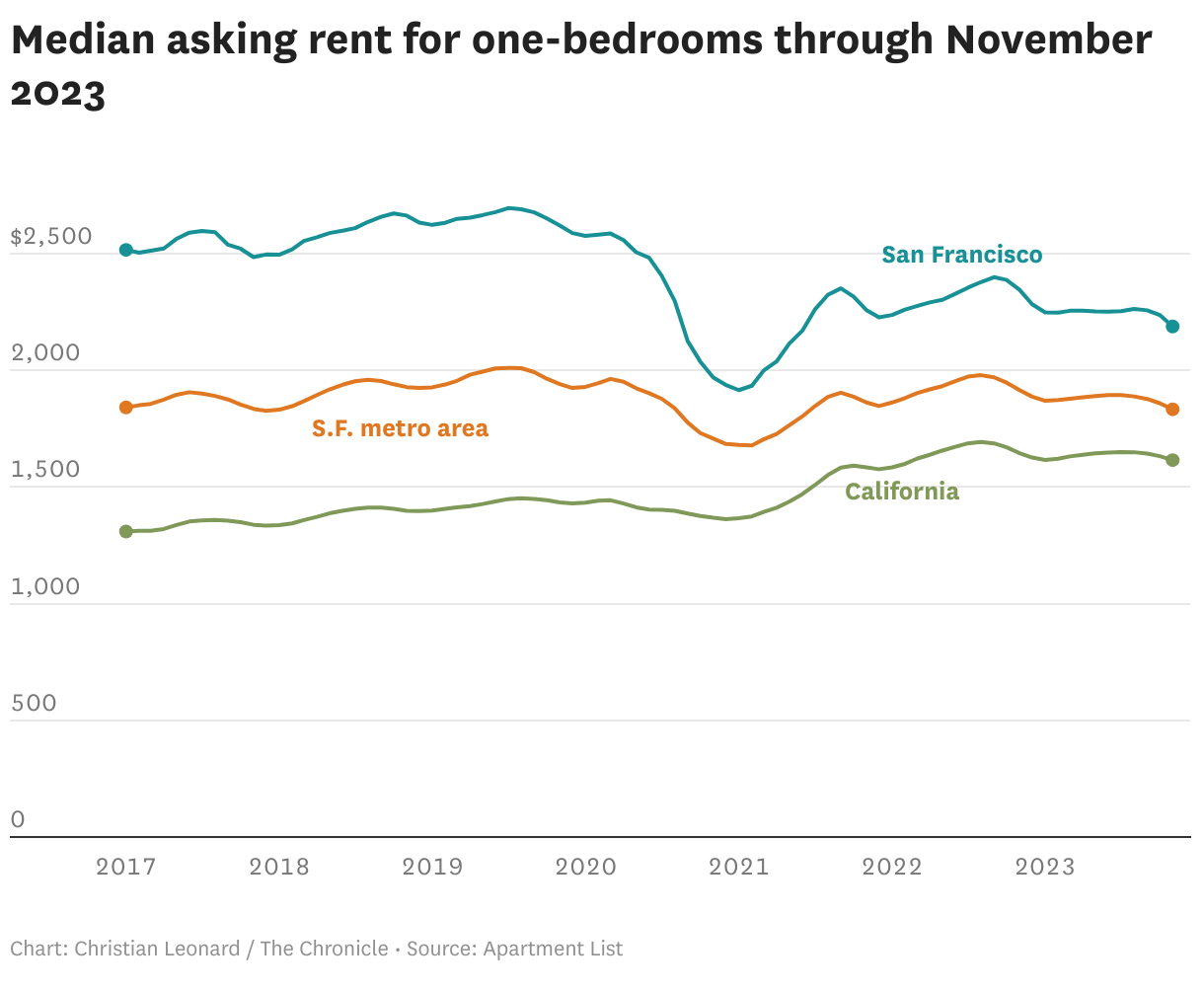 Median one-bedroom rent in SF and California. Source: SF Chronicle.
Hacker houses: the fast lane
Hacker houses sit outside the typical framing but for many founders are the fastest entry into the city. The value isn't shared rent — it's density in compressed form. You're living with people building, raising, and shipping in real time, which accelerates introductions. It's intense and not for everyone, but it shortens the time-to-embedded dramatically. Where you live shapes the loop you enter and the pace you operate at.
3. Your first 30 days: what to do and what to resist
Most founders don't fail in SF because of bad ideas. They lose momentum early by misusing their first month. The instinct is to maximize exposure immediately — meet everyone, start pitching. The result is shallow connections, scattered thinking, and nothing to show for it. The first 30 days are about sequencing.
Week 1 — Build a base before you build a network
The most common mistake is networking before you're settled. Founders land, open Luma, RSVP to everything, and spend evenings introducing themselves with no context to anchor those conversations. Get the base in place first: stable housing, a working routine, and a clear sense of where your days will happen. Find a workspace you can return to consistently — even if it's just a shared office or a reliable cafe. Without that, conversations don't compound because you don't show up in the same places twice.
Week 2 — Show up small, not loud
Once settled, start showing up — but not everywhere. The highest-value interactions rarely happen at large events. They happen in small rooms of 20–50 people where conversations have time to develop: founder dinners, small meetups, informal gatherings. Begin scheduling a few coffee chats per week with people slightly ahead of you or in adjacent areas. The goal is not to pitch — it's to listen, ask good questions, and build context. Going broad (attending everything, meeting everyone, remembering no one) feels productive but compounds nothing.
Week 3 — Ship something, even if it's incomplete
By week three you should have enough context to start building in public rather than in stealth. This doesn't mean a full product launch — a landing page, a small demo, or even a clear articulation of what you're working on is enough. In SF, people respond differently once there's something concrete to react to: feedback gets sharper and introductions get more relevant. The failure mode is waiting too long, refining privately to make the idea perfect, which slows feedback exactly when it matters most.
Week 4 — Build your core loop
By week four, patterns emerge. You notice which conversations were useful, who followed up, where you felt the most energy. You don't need a large network — you need a small group you can return to regularly. Five is a good number. Founders, operators, or investors who understand what you're doing and engage consistently. Pair that with a basic rhythm: a place to work from and a handful of recurring interactions that structure your week. Without rhythm, the city feels noisy instead of useful.
The 30-day gut check
By the end of month one, the signals are clear. You should have: stable housing, something shipped, and a few people you can call without it feeling transactional. If those aren't in place, it's almost always one of two mistakes — staying too isolated, or pitching before you had anything real to anchor the conversation. The founders who get the most out of SF treat the first month as setup. Once that foundation is in, everything that follows moves faster.
4. How fundraising actually works in San Francisco
Fundraising in SF looks structured from outside, but in practice it runs on pattern recognition, timing, and how information moves between people. The visible layer helps, but most of the real mechanics sit underneath.
The numbers (pre-seed and seed in 2026)
- Pre-seed rounds: typically $1M–$3M total, with individual checks of $250K–$750K depending on conviction.
- Seed rounds: typically $3M–$8M, with more coordinated participation.
- Default instrument: the YC SAFE — simple, widely accepted, avoids negotiation overhead that kills momentum.
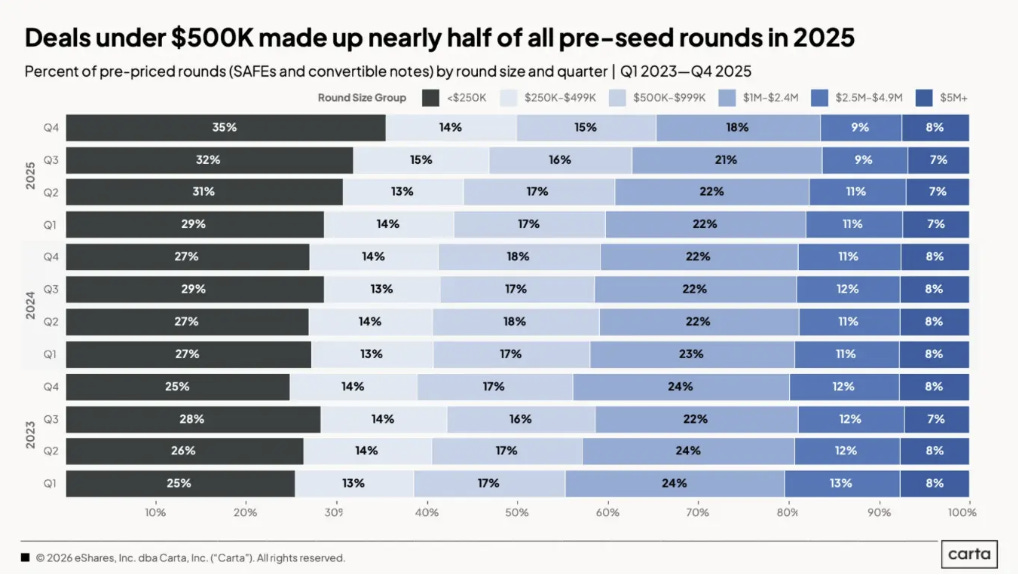 Sub-$500K deals dominate pre-seed funding in 2025. Source: Carta.
What investors are really evaluating
Structure alone doesn't explain why some founders get funded fast while others stall. At pre-seed, narrative carries as much weight as metrics. What matters is clearly explaining what you're building, why it matters now, and why you're the right person. Investors are comfortable backing companies before the data is obvious — they look for directional correctness and rate of learning. When those are clear, missing traction is much less of a blocker than founders assume.
A second misread: founders think in terms of firms, but decisions are made by individual partners. Each partner has their own taste, thesis, and internal credibility within the fund. Targeting the right partner matters far more than targeting the right logo on a website.
 Most important conversations happen one on one.
Why relationships shape the outcome
A cold email can work, but it competes with hundreds of others. A warm intro arrives with context and signals that someone the investor trusts has already formed an initial view on you. In a market where information travels quickly, that signal carries weight. This is why the best founders start building investor relationships before they're actively raising — by the time the round opens, the right people already have a mental model of what you're doing.
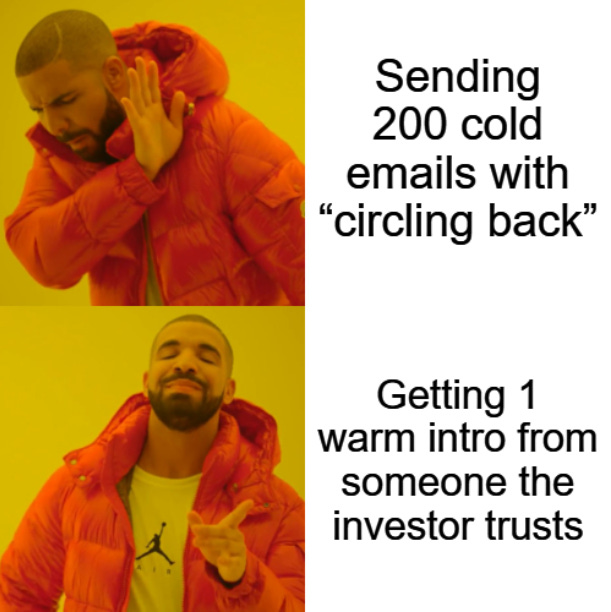 Warm intros beat cold outreach every time.
The pre-seed market is more specialized than ever
Different investors fit different founder profiles:
- Founders Inc. — close founder support, daily interaction (Fort Mason campus).
- Precursor — backs founders very early, sometimes before the idea is fully formed.
- Hustle Fund — known for speed and scrappy execution.
- 2048 — focuses on emerging technology.
- Unshackled — supports immigrant founders early, including with visa pathways.
Capital is the visible output. The real work is becoming legible within the system and reinforcing the right signal consistently.
5. Accelerators, communities, and where the real SF happens
Most founders arrive thinking in terms of programs and events. That's the visible layer — useful for orienting, but the real advantage sits in relationships, small groups, and repeated interactions.
The formal layer: programs that get you in
- Y Combinator — the most recognized path. The check isn't the main reason to apply; the real asset is the network. Alumni are responsive, intros move faster, credibility transfers in ways hard to replicate. You enter a feedback loop of founders who've built and scaled before you.
- Founders Inc. — its Fort Mason campus creates daily density most accelerators don't. You work near other founders, investors pass through regularly, and the line between building and networking blurs. Less structured than YC, more immersive.
- South Park Commons — for even-earlier founders, sometimes pre-idea. Leans toward exploration in a high-context environment; often sharpens ideas before anything is launched.
 Everything important is packed into a few square miles. Source: Fort Mason Center.
The informal layer: networks that decide how far you go
- Luma — public feed for what's happening across the city, from meetups to small gatherings.
- AI Tinkerers — consistent node for builders close to the technology itself.
- Bay Area Founders Club and similar groups — recurring touchpoints where relationships start.
But this is still surface-level. The more valuable opportunities are rarely posted publicly — they move through group chats, shared houses, small dinners, and introductions that happen because someone has seen you more than once. You don't access those by searching harder; you access them by being present long enough to become familiar.
Social platforms (mostly X) tie it together. Founders share what they're building, investors observe in real time, and conversations continue beyond physical rooms. The real SF emerges from how the formal and informal layers overlap — formal structures get you in, informal networks decide how far you go.
6. Visas, legal setup, and the things founders overlook
For non-US founders, this gets addressed too late. Most of it is predictable if you understand the paths early.
The two main visa routes
- O-1 visa — the primary path for founders with a strong professional track record. Framed as "extraordinary ability," but the bar is more achievable than most assume. If you have credible signals — publications, recognition, awards in your field — you're often closer than you think. Timelines run a few months from prep to approval if handled well.
- International Entrepreneur Parole (IEP) — alternative route, tied more directly to having secured funding and growth potential. Less common, but viable if you've already raised.
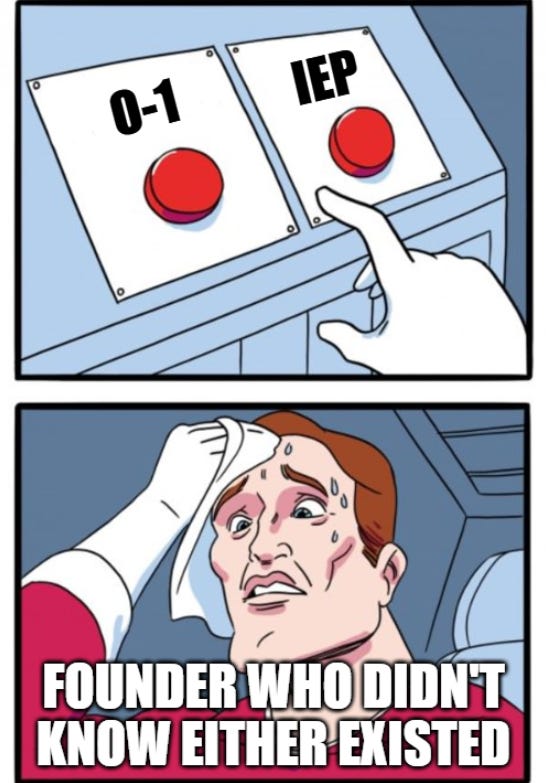 Most founders learn this too late.
Company structure
Default is a Delaware C-Corp — what most investors expect. Using anything else creates issues later. Stripe Atlas or Clerky make incorporation and early compliance easier. Get the structure right once so you don't have to revisit it mid-fundraise.
Practical levers founders miss
- SF currently offers a first-year business registration fee waiver — helps at the margin.
- Most early-stage companies qualify for startup credits from AWS, Google Cloud, and OpenAI. Apply early — many founders delay and miss meaningful runway extension.
Where cutting corners backfires
Legal counsel. Visa filings and incorporation are not areas to optimize for cost. Mistakes surface later — usually mid-raise or during expansion — and fixing them is always more expensive than doing it right upfront. Fragomen for immigration; Cooley and Wilson Sonsini for startup law. They're widely used because they understand how the pieces fit in a venture-backed context.
7. The honest case for and against making the move
SF is no longer a default decision. Cost is real even after rents softened, founders have left, and remote-first infra makes it possible to build, hire, and even raise without being there. So the move has to be specific.
When SF probably isn't worth it
- You're already at scale.
- You're building in a category where geography doesn't materially change access to talent or capital.
- Your network is already strong and your feedback loops are tight.
In those cases, the incremental benefit narrows and the cost and distraction can outweigh the upside.
When SF still pays off
Early-stage building is where SF's edge shows up. When you're still shaping the product, team, and narrative, proximity matters again. SF compresses the distance between idea and iteration — you meet people faster, test assumptions earlier, and adjust with better information. That speed prevents the mistakes that come from building in isolation.
There's also a cumulative layer that's hard to measure: relationships formed early tend to carry forward. People you meet when you have very little often reappear later as collaborators, hires, or investors. Being present when those networks are forming changes how you're positioned over time.
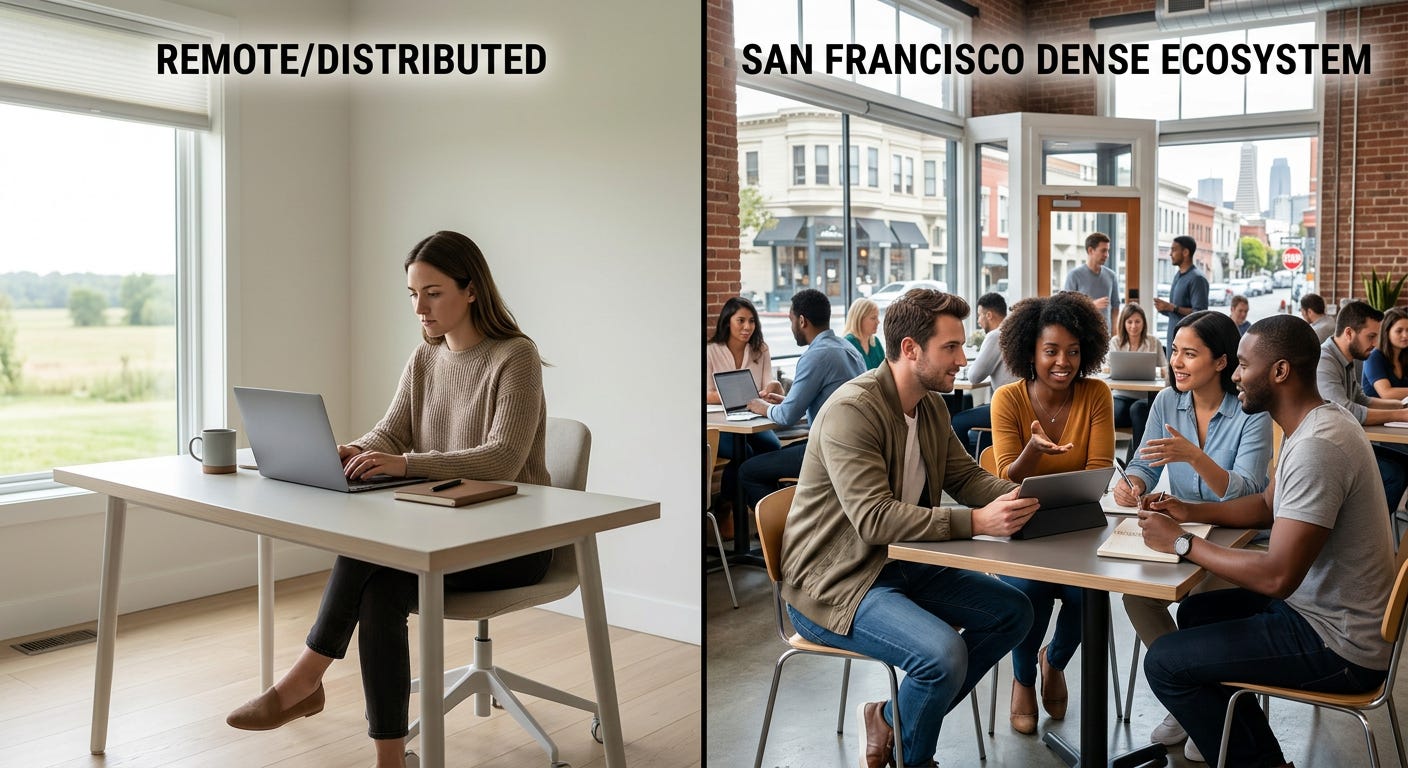 Remote is efficient, SF is fast.
The honest trade-off
None of this guarantees a better outcome — founders fail in SF for the same reasons they fail elsewhere. SF doesn't fix a weak idea or poor execution. What it does is increase exposure to conditions where better decisions get made more often.
The trade-off is straightforward: operate from a distance with more control over cost and environment, or step into a denser system where things move faster but demand more intentionality. If you choose the latter, show up with a plan. The advantage is still there — but it only becomes visible once you start participating in it.
TL;DR — a founder's checklist
- Move only if early-stage. Pre-PMF, pre-network founders gain the most; scaled or well-networked founders gain less.
- Pick your neighborhood for proximity, not aesthetics. SoMa for max density, Hayes Valley for balance, Dogpatch for YC clusters, hacker houses for fastest immersion.
- Sequence your first 30 days: base → small rooms → ship something → core loop of ~5 people. Don't pitch in week 1.
- Build investor relationships before you raise. Target partners, not firms. Warm intros >> cold email.
- Know the numbers: pre-seed $1–3M, seed $3–8M, default to YC SAFE.
- Get visas + legal right once. O-1 or IEP, Delaware C-Corp via Stripe Atlas/Clerky, real lawyers (Cooley, Wilson Sonsini, Fragomen).
- Claim the easy wins: SF first-year fee waiver, AWS/GCP/OpenAI startup credits.
- The real SF lives in group chats, dinners, and second encounters — not Luma. Show up consistently to become legible.
Author
Ruben Dominguez
Continued reading
Keep your momentum
MKT1 Newsletter
100 B2B Startups, 100+ Stats, and 14 Graphs on Web, Social, and Content
This is Part 2 of MKT1's three-part State of B2B Marketing Report. Where Part 1 looked at teams and leadership , Part 2 turns to what marketing teams are actually doing — what their websites look like, how they use social, and what "content fuel" they're producing. Emily Kramer u
Apr 28 · 10m
Lenny's Newsletter (Lenny's Podcast)
Why Half of Product Managers Are in Trouble — Nikhyl Singhal on the AI Reinvention Threshold
Nikhyl Singhal is a serial founder and a former senior product executive at Meta, Google, and Credit Karma . Today he runs The Skip ( skip.show (https://skip.show)), a community for senior product leaders, plus offshoots like Skip Community , Skip Coach , and Skip.help . Lenny de
Apr 27 · 7m
The AI Corner
The AI Agent That Thinks Like Jensen Huang, Elon Musk, and Dario Amodei
Dominguez opens with a claim that is easy to skim past but worth stopping on: the difference between elite founders and everyone else is not raw IQ or speed — it is that each of them has internalized a repeatable mental procedure they run on every important decision. The procedur
Apr 27 · 6m