Lenny's Newsletter
Hard Truths About Building in the AI Era — Keith Rabois on Hiring, PMs, and What Actually Wins
Lenny Rachitsky (interview with Keith Rabois, Khosla Ventures)
Apr 27, 2026
Hard Truths About Building in the AI Era — Keith Rabois on Hiring, PMs, and What Actually Wins
Source: Lenny's Newsletter • Author: Lenny Rachitsky (interview with Keith Rabois, Khosla Ventures) • Date: Apr 12, 2026 • Original article
⚠️ Note on completeness: The full body of this post is behind Lenny's paid subscriber paywall. This summary covers the publicly visible portions — the episode framing, the topics Keith promised to cover, the people/companies/concepts referenced, and the well-documented context for each idea (drawing on Keith Rabois's prior public talks, essays, and interviews that explain the same frameworks). Where a claim relies on the public teaser, it's presented as the thesis Keith argues; the in-episode nuance and any new examples behind the paywall are not captured here.
Who is Keith Rabois, and why listen to him?
Keith Rabois is one of the most distinctive operator-investors in Silicon Valley. The shorthand résumé:
- Early executive at PayPal (member of the so-called "PayPal Mafia" — the alumni group that went on to start or run Tesla, SpaceX, LinkedIn, YouTube, Yelp, Palantir, Affirm, and more).
- COO at Square under Jack Dorsey.
- VP of Corporate Development at LinkedIn.
- Early investor / board member in Stripe, DoorDash, Airbnb, YouTube, Ramp, Palantir, and others.
- Currently Managing Director at Khosla Ventures.
- Eccentric detail he likes to mention: he hasn't touched a laptop or desktop computer since September 2010 — he runs his entire professional life from an iPad. He uses this as proof that "what matters" in knowledge work is judgment and pattern-matching, not the keyboard.
When Rabois gives advice, it's grounded in having personally hired, fired, scaled, and bet money on the people who built the modern consumer-internet stack. He's also famously contrarian — he tends to argue against the consensus advice product people hear at conferences.
The seven hard truths he sets out to argue
The episode is structured around seven claims. Each is a counter-punch to something most founders and PMs currently believe.
1. Hire barrels, not ammunition
This is Rabois's most-cited hiring framework, going back to his Square and OpenStore days, and the episode opens on it.
The mental model. Imagine a gun. Ammunition is plentiful — you can buy it by the box. The barrel is the rare, expensive, precision-engineered piece that actually fires the ammunition into the target. Without a barrel, no amount of ammunition does anything; it just sits in a pile.
Translated to a company:
- Ammunition = capable individual contributors. Strong engineers, designers, marketers. They produce excellent work when pointed at a problem. They are essential, but they are also a commodity in a healthy talent market — you can recruit more of them.
- Barrels = people who can take a raw, ambiguous problem all the way to a shipped, working outcome — across functions — without being told how. A barrel will identify the problem, recruit the team, design the solution, ship it, measure it, and own the result. They convert "raw potential" (ammunition) into impact.
Why it matters. Most companies are bottlenecked on barrels, not headcount. Rabois argues the entire growth rate of a startup is essentially the rate at which you can find and hire barrels. Add ammunition before you have a barrel to point them and they sit idle; add a barrel and your output multiplies.
How to spot a barrel (the public version of the heuristic):
- Ask candidates for a project they owned end-to-end. A barrel describes the problem framing and trade-offs, not just the work output. Ammunition describes the tasks they did.
- Look for people who have changed scope on themselves — taken on adjacent responsibilities not in their job description, because the company needed it.
- Look for "scar tissue": did they see something through to a real outcome (a shipped product, a closed deal, a hired team), including the unglamorous final 20%?
- Reference checks: ask "Was this person a barrel or ammunition?" — most experienced operators immediately know the answer.
The trap Rabois warns about: barrels often have uneven résumés because they take risks. Ammunition often has clean résumés because they execute well inside structure. Pure pattern-matching on pedigree systematically over-selects ammunition.
2. Talking to customers is actively harmful for consumer products
This is the most contrarian claim in the episode, because it directly contradicts the standard product-management gospel ("get out of the building," "talk to users every week").
The argument. Consumer users cannot tell you what they want; they can only react to what already exists. If you ask them, they'll describe a faster horse (the Henry Ford line). Worse, they'll describe a faster horse with confidence, and a credulous PM will go build it, and the product will fail because the actual latent demand was for a car.
Rabois's claim is sharper than "users don't know what they want." It's: the act of organizing your roadmap around what users say will actively pull you toward incrementalism and away from the non-obvious feature that would actually win the market. The signal-to-noise ratio of customer interviews is so bad in consumer that it's a net negative input.
What to do instead (the implied alternative he champions in his other writing):
- For consumer, lean on taste and first principles — a strong founder's intuition about what should exist, then test by shipping.
- Use behavioral data (what people actually click, retain on, pay for) rather than stated preference (what they say in an interview).
- Reserve customer conversations for B2B contexts, where the buyer can actually articulate the workflow pain because they live it professionally every day.
The key distinction is consumer vs. enterprise. He is not saying ignore customers in B2B. He's saying the famous "talk to users" advice was forged in B2B SaaS and gets misapplied to consumer apps where it does damage.
3. The PM role is dying
Rabois argues that the traditional Product Manager role — the person who writes specs, runs standups, prioritizes a backlog, and coordinates between design and engineering — is being collapsed by AI.
Why now. Two forces are squeezing the PM from both sides:
- From below, AI coding tools (Claude Code, Cursor, Lovable) let an engineer or designer go from idea to working prototype in hours. The PM-as-translator (turning fuzzy intent into a written spec) is no longer the bottleneck because the cost of just trying it has collapsed.
- From above, founders and senior leaders increasingly want to talk directly to the people making the product, not to a coordinator in the middle. The "PM as project manager" function is automatable.
What survives. The part of the PM job that's taste, judgment, and strategy — deciding what to build, why, and what to kill — is more valuable than ever. But that work increasingly accrues to engineers with product instincts, designers with product instincts, or founders themselves. The "pure" PM whose only skill is the meta-work around product gets squeezed out.
This connects to a parallel claim Lenny has run elsewhere on the newsletter (e.g. Nikhyl Singhal's "Why half of product managers are in trouble," Cat Wu on Anthropic's product team, Jenny Wen on the design process being dead) — the message across these episodes is consistent: the AI era rewards fewer, more senior, more end-to-end people, not large coordinator-heavy product orgs.
4. The three traits of the best-performing companies right now
Rabois names three traits that, in his portfolio observation, separate the AI-era winners from the laggards. Based on his public talks and writing, the three are:
- Velocity. The single best leading indicator of success is shipping rate. Top companies (Ramp, Lovable, Faire under Max Rhodes, DoorDash early on) compound because they ship 5–10× more iterations per quarter than competitors. Velocity isn't about working longer hours; it's about removing internal friction — fewer approvals, smaller teams, no committee decisions.
- Vertical integration / end-to-end ownership. Rabois has long argued (his pinned 2017 X post on vertical integration) that the durable AI-era winners own the full stack of their customer's experience — model + product + distribution + sometimes hardware — rather than being a thin wrapper. In an era when wrappers are commoditized weekly, owning more of the stack is the moat.
- Founder-led taste. A single decision-maker with strong aesthetic and product taste, in the chair, deciding. The companies that flounder are the ones that try to A/B-test their way to a product vision or run it by committee.
5. The interview question he asks every senior candidate
Rabois has a single question he treats as load-bearing for senior hires. The publicly known version of this (from his prior talks and Delian Asparouhov's "Lessons from Keith Rabois" essays) is some variant of:
"What is the single biggest impact you've personally had on a company, and how would I verify that with a reference?"
The question is engineered to do three things at once:
- It forces the candidate to rank their own contributions, which reveals whether they think in terms of impact (barrel) or activities (ammunition).
- The "how would I verify" clause makes it expensive to inflate, because they know you might actually call.
- It surfaces whether the candidate has a clear theory of their own value — senior people who can't articulate their #1 impact in one sentence usually weren't actually the driver.
A strong answer is specific, measurable, and includes the trade-offs and the team. A weak answer is generic ("I led a team of 20") or all credit ("I single-handedly...").
6. CMOs — not engineers — are becoming the #1 consumer of AI tokens
This is a counterintuitive prediction about where AI spend will actually concentrate.
The thesis. Most coverage assumes engineering teams will dominate AI consumption (code generation, agents writing code). Rabois argues the much bigger token-buyer over the next few years will be marketing, specifically Chief Marketing Officers, because:
- Marketing is content-volume bound. A modern marketing org needs personalized landing pages, ad creative variants, email sequences, SEO content, social posts, and now AEO (Answer Engine Optimization) — content optimized to be cited by ChatGPT, Perplexity, and Google's AI Overviews. Each of those is a token-hungry generation task at massive scale.
- Tools like Profound (referenced in the episode) are emerging specifically to help CMOs optimize their presence inside AI answer engines, the new SEO.
- Engineering token spend, while real, is bounded by the number of engineers. Marketing token spend scales with audience size and channel count — a much bigger denominator.
For founders selling AI infrastructure, the implication is to point your GTM at the CMO, not just the CTO.
7. How to identify undiscovered talent
Rabois's edge as both an operator and an investor has been hiring people before they were obviously great — Jack Dorsey, Max Levchin, David Sacks, Tony Xu, Eric Glyman, and others. His public heuristics:
- Look for the slope, not the intercept. Don't compare candidates' current titles; compare how fast they've grown. Someone who went from intern to VP in four years at a no-name company is more interesting than a 15-year veteran at a brand-name one.
- Look outside the obvious pipelines. Top schools and FAANG résumés are over-fished. The best undiscovered talent is hiding in second-tier schools, non-traditional backgrounds, and roles where they over-performed their title.
- Trust the references of people who themselves are great. A strong endorsement from someone you respect is worth more than any interview. Top operators tend to know other top operators early — by the time the broader market notices, the price has gone up.
- Look for obsession. People who over-prepare, who have read everything in their domain, who do the work nights and weekends because they enjoy it — these are the asymmetric bets. Bill Belichick's "NO DAYS OFF" tweet is referenced in the episode as the work-ethic standard.
Background context that makes the episode click
A few things worth knowing as a beginner if you're going to read or listen to the full piece:
- PayPal Mafia. The group of early PayPal employees (Thiel, Musk, Levchin, Hoffman, Sacks, Rabois, etc.) who fanned out to start or fund a disproportionate share of major tech companies. When Rabois name-drops these people, it's not pure flex — they're the network whose hiring patterns inform his frameworks.
- "Barrels vs. ammunition." The phrase is widely attributed to Rabois (he's been using it publicly for over a decade), and it has become standard vocabulary inside many YC-era startups.
- AEO (Answer Engine Optimization). The new discipline replacing classic SEO. Where SEO optimizes to rank in Google's blue links, AEO optimizes to be the source an LLM cites in its answer. This is the wedge Profound and similar tools are exploiting.
- Vertical integration. A recurring Rabois thesis: in markets where the model layer is commoditized, owning the full stack (model + product + distribution) is what produces durable margins. Opendoor (which he co-founded) was an early bet on this idea in real estate.
Recommended further reading from the episode
- Creativity, Inc. by Ed Catmull — on building a creative organization (Pixar).
- The Jordan Rules by Sam Smith — on what it actually looks like to be obsessive about winning.
- The Upside of Stress by Kelly McGonigal — on reframing high-pressure work as fuel.
- Delian Asparouhov's "Lessons From Keith Rabois" essay series — the most thorough public distillation of Rabois's operating playbook.
- Lenny's adjacent episodes on the same theme: Nikhyl Singhal on PMs in trouble, Boris Cherny on Claude Code, Jenny Wen on design, Geoff Charles on Ramp's velocity.
The one-line takeaway
Rabois's worldview, compressed: In the AI era, the winning company is a small group of barrels with strong taste, shipping at high velocity, owning the full stack, hiring on slope rather than pedigree, ignoring what consumer users say they want, and treating the marketing-content layer (not the engineering layer) as the real frontier of AI consumption. Everything else in the episode is a corollary of that.
Author
Lenny Rachitsky (interview with Keith Rabois, Khosla Ventures)
Continued reading
Keep your momentum
MKT1 Newsletter
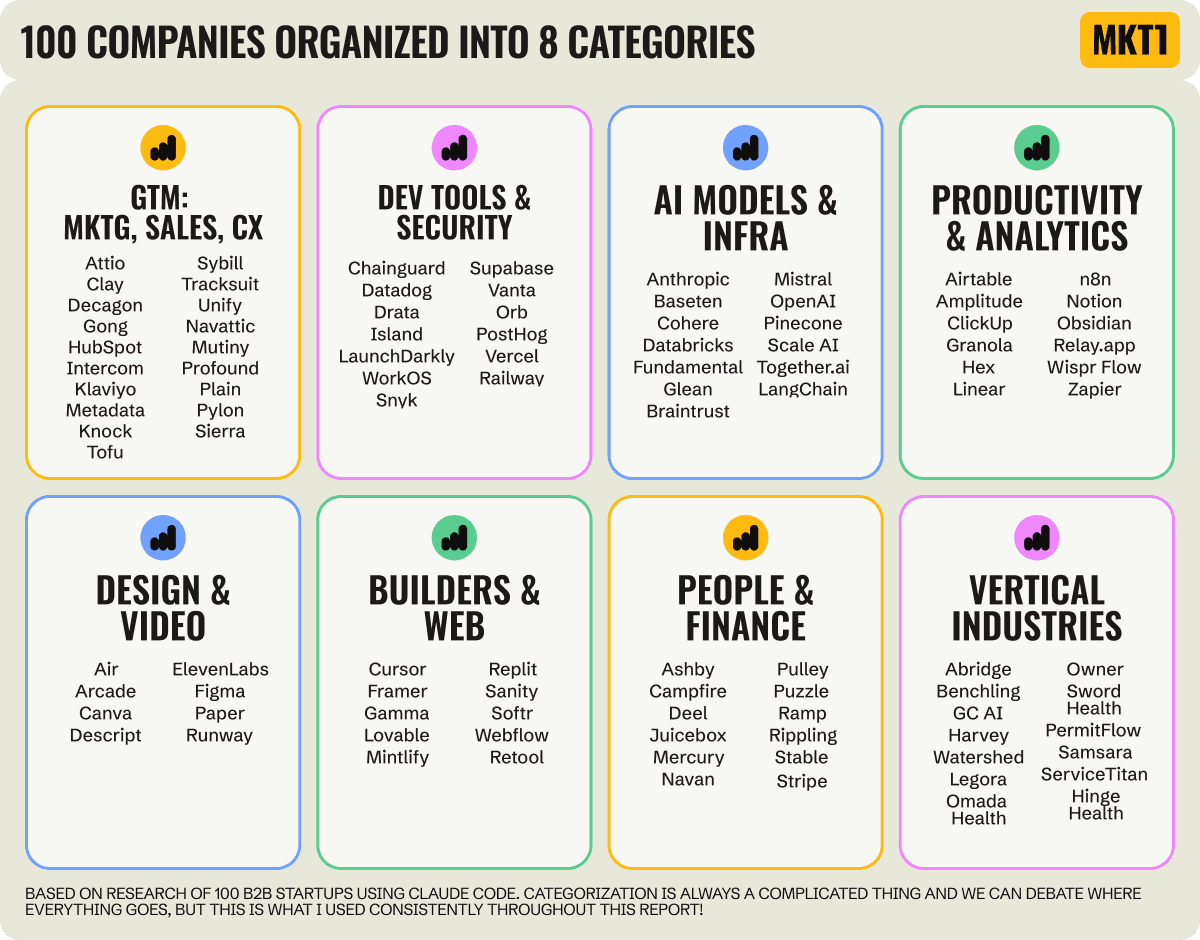
100 B2B Startups, 100+ Stats, and 14 Graphs on Web, Social, and Content
This is Part 2 of MKT1's three-part State of B2B Marketing Report. Where Part 1 looked at teams and leadership , Part 2 turns to what marketing teams are actually doing — what their websites look like, how they use social, and what "content fuel" they're producing. Emily Kramer u
Apr 28 · 10m
Lenny's Newsletter (Lenny's Podcast)
Why Half of Product Managers Are in Trouble — Nikhyl Singhal on the AI Reinvention Threshold
Nikhyl Singhal is a serial founder and a former senior product executive at Meta, Google, and Credit Karma . Today he runs The Skip ( skip.show (https://skip.show)), a community for senior product leaders, plus offshoots like Skip Community , Skip Coach , and Skip.help . Lenny de
Apr 27 · 7m

The AI Corner
The AI Agent That Thinks Like Jensen Huang, Elon Musk, and Dario Amodei
Dominguez opens with a claim that is easy to skim past but worth stopping on: the difference between elite founders and everyone else is not raw IQ or speed — it is that each of them has internalized a repeatable mental procedure they run on every important decision. The procedur
Apr 27 · 6m