The AI Corner
25 Claude Skills That Give Your Startup a Marketing Team It Cannot Afford Yet
Ruben Dominguez
Apr 27, 2026
25 Claude Skills That Give Your Startup a Marketing Team It Cannot Afford Yet
Source: The AI Corner · Author: Ruben Dominguez · Date: Apr 17, 2026 · Original article
The problem this solves: the "rebuild tax"
Every early-stage startup hits the same wall. You have five marketing problems to solve at the same time, budget for maybe one hire, and that one hire ends up rebuilding the same workflows from scratch every campaign.
- The launch email sequence? Gone after the launch.
- The cold-outreach scripts? Rewritten for the next ICP (Ideal Customer Profile — the type of buyer you're targeting).
- The hook tests? Started over every quarter.
The author calls this the rebuild tax. It's not a talent problem; it's an infrastructure problem. The fix is Claude Skills.
What is a Claude Skill (in plain English)?
A Skill is a reusable instruction set saved as a markdown file. You encode a process once — with your ICP, your positioning, your voice, your standards — and Claude executes it identically every time you trigger it.
Compare it to the alternative:
- A prompt disappears when the conversation ends. You re-type the context next time.
- A Skill lives permanently. Claude activates it automatically whenever the task you describe matches the Skill's purpose. You don't even have to remember to invoke it.
The mental model: a prompt is like explaining a recipe to a chef every single dinner. A Skill is hiring a chef who already knows the recipe and your kitchen. The author quotes a guiding rule:
"Every time you do something and think 'I'll probably need to do this again,' make it a Skill. Skills compound."
This matters even more now that Claude Opus 4.7 shipped with substantially better instruction-following and a new "xhigh" effort level — Skills built on a better model compound faster.
Why this is leverage, not just convenience
The author's core insight on why Skills matter strategically:
Slow experimentation happens when the overhead of running a test dwarfs the time spent on strategic thinking. The handoff from insight to execution is where momentum dies.
Skills go straight from raw input to executable campaign asset in one pass. They eliminate the translation layer between thinking and shipping. At Series A, that translation layer costs weeks per quarter. At pre-seed, it costs the founder days they don't have.
The result: your one marketing hire runs like three. A co-founder doing scrappy marketing performs at senior practitioner quality. A new hire on day one matches the output of someone who's been there a year — because the Skills carry the institutional knowledge.
How to install any Skill in this article
- Open Claude Cowork (Claude's workspace product) or Claude Chat.
- Paste the prompt provided for the Skill.
- Claude generates the Skill file automatically.
- Save it via Settings → Capabilities → Skills.
Critical prerequisite — build your brand context file first. Store your ICP, positioning, tone rules, and differentiators in your ABOUT ME folder. Every Skill reads this before executing. Without it, Skills produce good generic output. With it, they produce output that sounds like your company.
The 25 Skills
For each Skill below: what it does, why founders use it, and the copy-paste prompt that builds it.
Category 1 — Content Creation
Skill 1: Hook Creator
Generates 10 hooks for any content using 8 proven copywriting frameworks. Each output is labeled with the framework so you know which angle you're testing and why.
Why: Your content either stops a reader or scrolls past. This Skill applies frameworks top copywriters charge thousands for, on demand.
When: Email subject lines, social openers, ad headlines, landing-page copy, video titles.
Help me create a Skill called "Hook Creator" that generates
compelling hooks for any marketing content.

Output 10 options using at least 5 different frameworks.
Label each with the framework in brackets.

When invoked, ask me for:
1. Content type (email, social, ad, landing page, video)
2. Target audience
3. Main benefit or promise
4. Tone (professional, casual, urgent, playful)

Frameworks to use: Curiosity Gap, Pain-Agitation-Solution,
Benefit-Driven, Contrarian, Specific Numbers, Question + Benefit,
Social Proof, Urgency/FOMO, Transformation, Listicle.

Rules: under 100 characters when possible, at least 2 options
that challenge category norms, specific over generic.
Never use "game-changer," "revolutionary," or "unlock."
Save as a permanent Skill.
Skill 2: Video Script Generator
Full scripts for TikTok, Reels, YouTube Shorts, and long-form YouTube. Includes hook, value delivery, on-screen text callouts, shot suggestions, caption copy, and a thumbnail concept.
Why: Founders building personal brands cannot afford two hours on a script that takes 60 seconds to watch. This Skill handles structure so the thinking stays with you.
Help me create a Skill called "Video Script Generator" that
creates complete, platform-optimized video scripts.

When invoked, ask me for:
1. Platform (TikTok, Reels, YouTube Shorts, YouTube long-form)
2. Video length
3. Topic or message
4. Goal (educate, entertain, sell, build awareness)
5. Brand voice
6. Hook style (pattern interrupt, curiosity gap, bold statement)

Short-form structure (under 90 seconds):
- Hook: 0-3 seconds, pattern interrupt
- Value promise: 3-5 seconds
- Main content with on-screen text callouts
- CTA: last 5 seconds, one only

Long-form structure (90 seconds and above):
- Hook, intro, 3-5 main sections with mini-hooks, recap, CTA

Include timestamps, shot suggestions, music cues, caption copy.
One CTA only. Save as a permanent Skill.
Skill 3: Blog Post Writer
A complete SEO-optimized blog post from a brief: H1, meta title, meta description, hook intro, 4–6 sections, FAQ, CTA, and an internal-link map.
Why: Content compounds. Every article that ranks drives leads for years without ongoing spend. This Skill encodes your standards so every piece hits the same bar regardless of who writes it.
Help me create a Skill called "Blog Post Writer" that produces
complete, SEO-optimized blog posts from a topic brief.

When invoked, ask me for:
1. Topic and target keyword
2. Search intent (informational, commercial, navigational)
3. Target audience and their pain points
4. Desired word count
5. Competing articles to beat (URLs)
6. Internal links to include
7. CTA at the end

Output: H1, meta title, meta description, hook intro,
4-6 sections, FAQ, conclusion with CTA, image suggestions,
internal link placements.

Structure every section to answer the reader's next question
before they ask it. Write for one specific reader.
Never start with "In today's fast-paced world."
Save as a permanent Skill.
Skill 4: Content Repurposing Engine
Takes any long-form piece and produces a full repurposing map across seven platforms, each adapted to that platform's format and audience behavior.
Why: Most startups produce one piece of content and let it die. This extracts ten assets from every piece without repeating the same angle across channels.
Help me create a Skill called "Content Repurposing Engine" that
turns any long-form piece into platform-specific assets.

When invoked, ask me for:
1. Original content (paste or link)
2. Platforms to repurpose for
3. Brand voice
4. Primary CTA for each asset
5. Audience per platform (may differ)

Output per platform:
- LinkedIn: insight-driven hook, key takeaways, CTA
- Twitter/X: 6-8 tweet thread, strong opening, clear progression
- Instagram: carousel concept with slide-by-slide copy
- Newsletter: 120-150 words, subject line, CTA
- YouTube: outline with hook, 3-5 sections, CTA
- TikTok: 60-second script with pattern interrupt opening
- Lead magnet: outline for converting into downloadable resource

Vary the angle across channels. Same insight, different framing.
Never repeat the same opener. Save as a permanent Skill.
Skill 5: Podcast Content Repurposer
Transforms a podcast transcript into a multi-channel system: SEO show notes, LinkedIn post, Instagram caption + story frames, Twitter thread, email section, five pull quotes, three clip recommendations, and a standalone blog post.
Why: One conversation should produce ten distribution assets, not one.
Help me create a Skill called "Podcast Content Repurposer" that
turns podcast episodes into a multi-channel content system.

When invoked, ask me for:
1. Transcript or episode summary
2. Episode title and guest bio (if applicable)
3. Key listener takeaways
4. Target audience and tone
5. Distribution channels

Output:
- SEO show notes: timestamps, takeaways, resources, metadata
- Platform posts: LinkedIn, Instagram caption and story frames,
  Twitter thread, TikTok script
- Email section with 3 subject line options
- 5 pull quotes under 20 words each
- 3 clip recommendations with timestamps and suggested captions
- Standalone blog post: SEO title, 3-5 sections, CTA to listen

Vary angles across channels. Save as a permanent Skill.
Skill 6: Social Media Content Calendar
A full 30-day calendar across LinkedIn, Instagram, TikTok, X, and Facebook — full captions, hashtags, optimal post times, visual guidance, and a 40/30/20/10 content mix applied automatically.
Why: Inconsistent posting is a trust signal to investors and prospects. This gives a small team the volume of a dedicated social hire without the headcount.
Help me create a Skill called "Social Media Content Calendar"
that builds a complete month of strategic social content.

When invoked, ask me for:
1. Platforms and posting frequency
2. Business and brand info
3. Content pillars (3-5 themes)
4. Campaigns or launches to build around
5. Brand voice and primary goal

Output a table: Date | Platform | Content Type | Post Concept |
Full Caption | Hashtags | Post Time | Visual Format | CTA | Notes

Content mix: 40% educational, 30% engagement,
20% promotional, 10% behind-the-scenes.

Include cross-platform adaptation and batch creation guidance.
Save as a permanent Skill.
The "40/30/20/10" rule means: 40% of posts educate the audience, 30% drive engagement (questions, polls, opinions), 20% directly promote your offer, 10% show behind-the-scenes humanity. It keeps your feed from feeling like an ad reel.
Category 2 — Email & Lifecycle Marketing
Skill 7: Email Sequence Builder
Complete 3–7 email sequences for welcome flows, nurture campaigns, launches, and re-engagement. Each email includes 3 subject-line options, preview text, full body, CTA, and a success metric.
Why: Email is still the highest-ROI channel most startups have. This encodes your sequence architecture so every flow hits the same standard.
Help me create a Skill called "Email Sequence Builder" that
designs complete email sequences for any stage of the
customer journey.

When invoked, ask me for:
1. Sequence goal and type
2. Audience segment and number of emails (3-7)
3. Timing cadence and brand voice
4. Key value propositions and existing offers

For each email:
- Send timing and purpose
- 3 subject line options and preview text
- Full email body: hook, content, CTA
- Design notes and success metric

Each email must stand alone. Build urgency in 1 of 7 emails
maximum. Vary length and format across the sequence.
Save as a permanent Skill.
Skill 8: Newsletter Writer
Complete newsletter issues from a topic or brief: subject options, preview text, opening hook, main section, secondary story, curated resources, and closing CTA.
Why: Founder newsletters compound over years. Production becomes the friction; this Skill removes it so you focus on the insight, not the formatting.
Help me create a Skill called "Newsletter Writer" that produces
complete newsletter issues from a topic or brief.

When invoked, ask me for:
1. Main topic and secondary story or link
2. Audience, tone, and sponsor placement (if any)
3. CTA for this issue

Output:
- 3 subject line options and preview text
- Opening hook: 1-2 sentences, must stop someone mid-scroll
- Main section: 400-600 words
- Secondary story or curated picks
- Closing CTA and estimated read time

Write like a person, not a brand. Save as a permanent Skill.
Skill 9: Re-engagement Campaign Builder
A 3-email win-back sequence for cold subscribers or lapsed customers — personal rather than desperate, with a sunset email for those who still don't respond.
Why: Re-engaging existing contacts is the cheapest pipeline a startup has.
Help me create a Skill called "Re-engagement Campaign Builder"
that wins back cold subscribers and lapsed customers.

When invoked, ask me for:
1. Audience segment and length of inactivity
2. Last meaningful interaction and best reason to re-engage
3. Brand voice

Output a 3-email sequence:
Email 1: Acknowledge absence without guilt, offer real value
Email 2: Social proof or what they missed, clear benefit
Email 3: Honest sunset email, low-pressure farewell, final CTA

Each email: subject line, preview text, full body, timing.
Write like a human who genuinely wants them back.
Save as a permanent Skill.
Category 3 — SEO and AEO
A note on jargon: SEO (Search Engine Optimization) is optimizing content to rank in Google. AEO (Answer Engine Optimization) is optimizing content to be cited by AI search tools like ChatGPT, Claude, Perplexity, and Gemini. Both matter now because buyers increasingly start research in AI chat instead of Google.
Skill 10: SEO Content Optimizer
Audits existing content for SEO gaps — scores it, identifies structural weaknesses, outputs a prioritized fix list, and rewrites one section as a demonstration.
Why: Content you already have is the easiest traffic to recover.
Help me create a Skill called "SEO Content Optimizer" that audits
and improves content for search and AI citation performance.

When invoked, ask me for:
1. Content to analyze (paste or URL)
2. Target keyword and audience
3. Content goal and top competing URLs

Output:
- SEO score 1-10 with breakdown
- Top 3 structural weaknesses
- 5 specific changes to make immediately
- Missing entities, semantic gaps, subtopics to add
- AEO optimization: question-answer pairs and heading structures
  that help AI models cite the piece
- One rewritten section as example

Save as a permanent Skill.
Skill 11: AEO Content Optimizer
Optimizes content to be cited by AI search engines. Focuses on structured authority signals, direct-answer formatting, and entity density.
Why: AI search is now where buyers begin research. Being cited when a prospect asks an AI about your category is an organic channel most startups haven't invested in.
Help me create a Skill called "AEO Content Optimizer" that
structures content so AI models cite and recommend it.

When invoked, ask me for:
1. Content to analyze (paste or URL)
2. Primary query this should answer
3. Target audience and content format

Output:
- AEO score 1-10
- Structural weaknesses for AI parsing
- 5 immediate fixes
- Question-answer pairs to add
- Entity-based language improvements
- One rewritten section optimized for direct AI citation

Optimize for: descriptive headings, Q&A pairs,
authoritative direct answers, specific data with sources,
entity-based language, topic comprehensiveness.
Save as a permanent Skill.
Skill 12: Site Architecture Advisor
Reviews website structure and internal linking. Recommends topic clusters, pillar pages, silo structures, and internal-link opportunities.
Why: Most startup websites are a collection of pages rather than a system. Proper architecture multiplies the value of every piece of content you produce. (A "pillar page" is a comprehensive overview page that links out to many specific sub-articles. A "topic cluster" is the pillar plus its supporting articles. A "silo" groups closely related pages so search engines understand you have depth on a topic.)
Help me create a Skill called "Site Architecture Advisor" that
improves website content structure for SEO performance.

When invoked, ask me for:
1. Website URL or sitemap and primary topics
2. Top 5 pages by traffic and business goals
3. Existing pillar pages if any

Output:
- Current architecture diagnosis
- Topic cluster recommendations with pillar and supporting pages
- Internal linking map
- Pages to consolidate or expand
- Missing content in each cluster
- Priority fix order with expected SEO impact

Save as a permanent Skill.
Skill 13: Keyword Research Strategist
A prioritized keyword strategy from a topic area or product category — primary keywords, long-tails, question-based queries, semantic clusters, and a content angle for each.
Why: Keyword strategy without structure produces random content. This builds the architecture that makes every article compound toward the same traffic goals.
Help me create a Skill called "Keyword Research Strategist" that
builds prioritized keyword plans for content programs.

When invoked, ask me for:
1. Topic area or product category
2. Target audience and business stage
3. Competing sites to benchmark against
4. Content types I can produce

Output:
- Primary keywords with estimated intent and difficulty
- Long-tail variations and question-based queries
- Semantic clusters to build content around
- Content angle per cluster
- 30-day content calendar suggestion

Save as a permanent Skill.
Category 4 — Paid Advertising
Skill 14: Ad Creative Refresher
Diagnoses creative fatigue (when ads stop working because audiences have seen them too many times) and generates a hook-and-angle matrix: 20 concepts across pain-focused, aspiration-focused, social-proof, urgency, and contrarian framings. Includes A/B test structure and platform-specific adaptations.
Why: Most startups run the same creative for three months because generating new concepts takes time they don't have. This turns a 2-hour process into 15 minutes.
Help me create a Skill called "Ad Creative Refresher" that
diagnoses creative fatigue and generates new hooks and angles.

When invoked, ask me for:
1. Platform, current creative, and performance metrics
2. Offer, target audience, and what has stopped working

Output:
- Fatigue signals diagnosis
- Hook matrix: 20+ concepts across pain-focused,
  aspiration-focused, social proof, urgency, contrarian
- Top 5 hooks to test first with rationale
- A/B test structure with success metrics
- Platform-specific adaptations and format variations

Every concept must be specific to the offer.
Save as a permanent Skill.
Skill 15: Paid Ads Auditor
Structured audit of a Google Ads or Meta account. Identifies wasted spend, negative keyword gaps, audience overlap, creative fatigue, and bid-strategy mismatches.
Why: The average Google Ads account wastes 20–30% of spend on irrelevant search terms. At early-stage budgets, that's real runway.
Help me create a Skill called "Paid Ads Auditor" that runs
structured audits of paid advertising accounts.

When invoked, ask me for:
1. Platform and account performance data (CSV or key metrics)
2. Business goal, budget allocation, and top campaigns

Output:
- Wasted spend: campaigns with spend and zero conversions
- Quality Score or relevance issues
- Audience overlap and creative fatigue signals
- Bid strategy mismatches
- Prioritized fix list: impact vs. effort
- Quick wins implementable in under 1 hour

Save as a permanent Skill.
Skill 16: A/B Test Setup Generator
Statistically rigorous A/B test design: hypothesis, sample size, test duration, success metrics, and analysis plan.
Why: Founders run tests without enough statistical power and make decisions on noise (random variation that looks like a real difference but isn't). This produces the correct setup so tests are worth running.
Help me create a Skill called "A/B Test Setup Generator" that
designs rigorous marketing experiments.

When invoked, ask me for:
1. What I want to test and current baseline metric
2. Minimum improvement needed before acting
3. Audience size available and platform

Output:
- Specific, falsifiable test hypothesis
- Control and variant definitions
- Sample size for statistical significance
- Recommended test duration and success metrics
- Common mistakes to avoid for this test type

Save as a permanent Skill.
Category 5 — CRO and Copy
CRO = Conversion Rate Optimization — making the same traffic convert to more signups, sales, or leads.
Skill 17: Landing Page CRO Reviewer
Audits a landing page against CRO best practices — headline clarity, value-proposition strength, social-proof placement, CTA friction, and form design — and scores each.
Why: A 1% improvement in conversion rate outperforms a 2x increase in ad spend. Find the improvements before spending more on traffic.
Help me create a Skill called "Landing Page CRO Reviewer" that
audits landing pages for conversion rate optimization.

When invoked, ask me for:
1. Landing page URL or paste
2. Goal, target audience, and traffic source
3. Current conversion rate if known

Output:
- CRO score 1-10 with category breakdown
- Above-the-fold diagnosis: headline, subhead, CTA, visual
- Value proposition and social proof assessment
- CTA analysis: copy, placement, friction
- 5 specific changes ranked by impact
- Rewrite of headline and CTA as example

Save as a permanent Skill.
Skill 18: Copywriting Refresher
Edits and improves existing marketing copy. Flags weak headlines, passive voice, vague benefit language, buried CTAs, and generic claims. Returns a clean edited version with change notes.
Why: Most startup copy is written in "founder mode" and reads like a features list. This translates features into outcomes and corporate language into human language.
Help me create a Skill called "Copywriting Refresher" that edits
and improves existing marketing copy.

When invoked, ask me for:
1. Copy to improve (paste the text)
2. Page type, target audience, goal, and brand voice

Output:
- Diagnosis: what is weak and why
- Full edited version with changes tracked in [brackets]
- 3 headline alternatives and 3 CTA alternatives
- One-sentence summary of what improved and why

Save as a permanent Skill.
Skill 19: Homepage Copy Generator
Conversion-focused homepage copy from scratch: hero headline + subhead, value proposition, feature-to-benefit section, social proof block, FAQ, and CTA structure.
Why: Your homepage is the first impression for every investor, prospect, and recruit.
Help me create a Skill called "Homepage Copy Generator" that
writes conversion-focused homepage copy.

When invoked, ask me for:
1. Product description and target audience pain point
2. Top 3 benefits (not features)
3. Best social proof, primary CTA, and brand voice

Output:
- Hero: headline under 10 words, subhead, CTA
- Value proposition block (3 benefits with brief copy)
- Feature-to-benefit section (outcomes, not functionality)
- Social proof block: testimonial format, stat callouts
- FAQ section (3-5 questions, direct answers)
- Secondary CTA for hesitant visitors

Write to one specific reader. Save as a permanent Skill.
Category 6 — Research and Positioning
Skill 20: Competitor Content Gap Analyzer
Analyzes 3–5 competitors to find topics they rank for that you don't, content they cover shallowly, formats they ignore, and questions nobody answers well. Returns a prioritized gap table and 10 quick-win content ideas.
Why: Most startup content strategies are built by looking inward. This shows where the audience is underserved before you write a single word.
Help me create a Skill called "Competitor Content Gap Analyzer"
that identifies content opportunities competitors are missing.

When invoked, ask me for:
1. My website or business description
2. 3-5 competitor URLs and content goals
3. Content types I can produce and resources available

Output:
1. Competitor overview table: strengths, weaknesses,
   top keywords, content frequency
2. Prioritized gap opportunities: topic, gap type,
   difficulty, impact, unique angle, format
3. Top 10 quick-win content ideas: title, reason,
   difficulty, keyword target
4. 3-5 long-term pillar opportunities

Focus on results, not just traffic. Save as a permanent Skill.
Skill 21: Customer Research Synthesizer
Synthesizes raw customer research (interviews, surveys, reviews, support tickets) into actionable marketing insights: ICP summary, top pain points, voice-of-customer language, objection map, and messaging recommendations.
Why: Most startups have raw customer data scattered across docs. This turns it into copy you can use immediately, in the exact words your customers already use. (That last detail matters: copy that uses customer phrasing converts better because it feels recognized, not pitched at.)
Help me create a Skill called "Customer Research Synthesizer"
that turns raw customer data into actionable marketing insights.

When invoked, ask me for:
1. Raw research to analyze (interviews, reviews, surveys,
   support tickets)
2. Product context and marketing question I am trying to answer
3. Current messaging hypothesis

Output:
- ICP summary: demographics, role, context, goals
- Top 3 pain points with supporting quotes
- Voice-of-customer language: exact phrases for copy
- Objection map: what stops them from buying
- Jobs-to-be-done insights
- Messaging recommendations and 3 copy angles to test

Save as a permanent Skill.
Skill 22: Positioning and Messaging Strategist
A positioning strategy and messaging hierarchy — category definition, differentiated value proposition, key messages per segment, and an architecture you can hand to any writer or agency.
Why: Getting positioning wrong costs months of misdirected content and ad spend. This produces a foundation document every downstream piece of work can build on.
Help me create a Skill called "Positioning and Messaging Strategist"
that builds positioning strategy and messaging architecture.

When invoked, ask me for:
1. Product description and target audience
2. Top 3 competitors and what differentiates me
3. Best customer outcomes and proof points

Output:
- Category frame and target audience definition
- Differentiated value proposition (one clear sentence)
- Key messages per audience segment with proof points
- What to stop saying (positioning anti-patterns)
- Messaging architecture: primary, secondary, tertiary claims

Save as a permanent Skill.
Skill 23: Problem Diagnostician
A rapid-fire marketing troubleshooter. Diagnoses low open rates, poor conversion, ad fatigue, declining engagement. Returns a root cause, three quick wins doable in under an hour, and two strategic fixes.
Why: When a channel underperforms, most teams guess. This produces a structured diagnosis before anyone wastes time optimizing the wrong variable.
Help me create a Skill called "Problem Diagnostician" that
quickly diagnoses marketing problems and provides specific fixes.

When invoked, ask me for:
1. Problem description and current metrics
2. Channel, what I have already tried, and target audience

Determine whether the root cause is a messaging, audience,
timing, creative, or funnel problem.

Output:
- Likely root cause (1-2 sentences)
- 3 Quick Wins implementable in under 1 hour
- 2 Strategic Fixes for higher impact
- What to A/B test first and what success looks like in metrics

Solutions must be specific, not generic.
Save as a permanent Skill.
Category 7 — Growth and Strategy
Skill 24: Product Launch Playbook Generator
A complete go-to-market launch plan with pre-launch, launch day, and post-launch phases — specific tasks, copy assets, channel recommendations, and success metrics for each.
Why: Launches without a system produce a spike and a cliff. This builds the architecture that turns a launch moment into a sustained growth phase.
Help me create a Skill called "Product Launch Playbook Generator"
that builds complete go-to-market launch plans.

When invoked, ask me for:
1. Product being launched and target audience
2. Launch date, runway, channels, goal, and budget

Output a phased plan:

Pre-launch: teaser content, waitlist, press prep,
  partner outreach, internal enablement

Launch day: announcement sequence, social posts,
  email to list, PR push

Post-launch: follow-up content, case studies,
  ad creative, retargeting, testimonial collection

Each phase: specific tasks, copy assets, channel sequence,
success metric. Save as a permanent Skill.
Skill 25: Churn Prevention Playbook
A complete churn-prevention system: early warning signals, intervention messages for each churn stage, a cancellation recovery flow, and a win-back campaign for those who already left.
Why: For SaaS startups, churn is the silent burn. Every customer retained compounds. Most startups defer building retention infrastructure until it's too late.
Help me create a Skill called "Churn Prevention Playbook" that
builds a complete retention and recovery system.

When invoked, ask me for:
1. Product type, subscription model, and average customer lifetime
2. Known churn triggers, current cancellation flow, brand voice

Output:

Early warning system: churn signals at 30, 60, and 90 days
  with intervention triggers

Intervention messages by stage:
- Usage drop: re-engagement email with specific value reminder
- Support friction: proactive outreach template
- Pricing concern: response framework and offer options
- Competitor evaluation: differentiation message

Cancellation flow: what to say at each step to attempt recovery

Win-back campaign: 3-email sequence for already-churned users
  with timing, angle, and offer for each email

Save as a permanent Skill.
How to build the system, not just the Skills
Twenty-five Skills is the inventory. The system is what generates the compounding returns. The author's recommended build order:
- First — your brand context file. ICP, positioning, tone rules, messaging framework. Stored in your ABOUT ME folder. Every Skill reads it automatically. This single file is what separates generic output from output that sounds like your company.
- Second — Skills 20–22 (research and positioning cluster). Everything else gets sharper when the foundation is clear. Don't skip to tactics before the strategy is documented.
- Third — the Skills covering your highest-frequency work.
- Email driving pipeline → start with Skills 7–9.
- Organic content as primary channel → Skills 1–6 and 10–13.
- Paid as growth lever → Skills 14–16.
The author's payoff line:
The first Skill saves you an hour. The twenty-fifth saves you a full day every week.
FAQ highlights
- What is a Claude Skill? A reusable instruction set saved as a markdown file. Claude activates it automatically when you describe a matching task — no need to re-explain the process.
- How long to build one? Roughly two minutes: paste the prompt, Claude generates the file, save to your Skills folder.
- What should I build first? The brand context file. Without it, output is generic. With it, output sounds like your company.
- Skills vs. standard prompts? Standard prompts require re-explaining context every conversation. Skills encode that information once in a permanent file.
- Team use? Yes — Skills saved in a shared Claude workspace are available to every team member, with consistent positioning, tone, and quality.
- Do new models help? Meaningfully. Claude Opus 4.7 has substantially better instruction-following than 4.6. Skills that produced 80% of what you wanted before now often produce 95%.
Author
Ruben Dominguez
Continued reading
Keep your momentum
MKT1 Newsletter
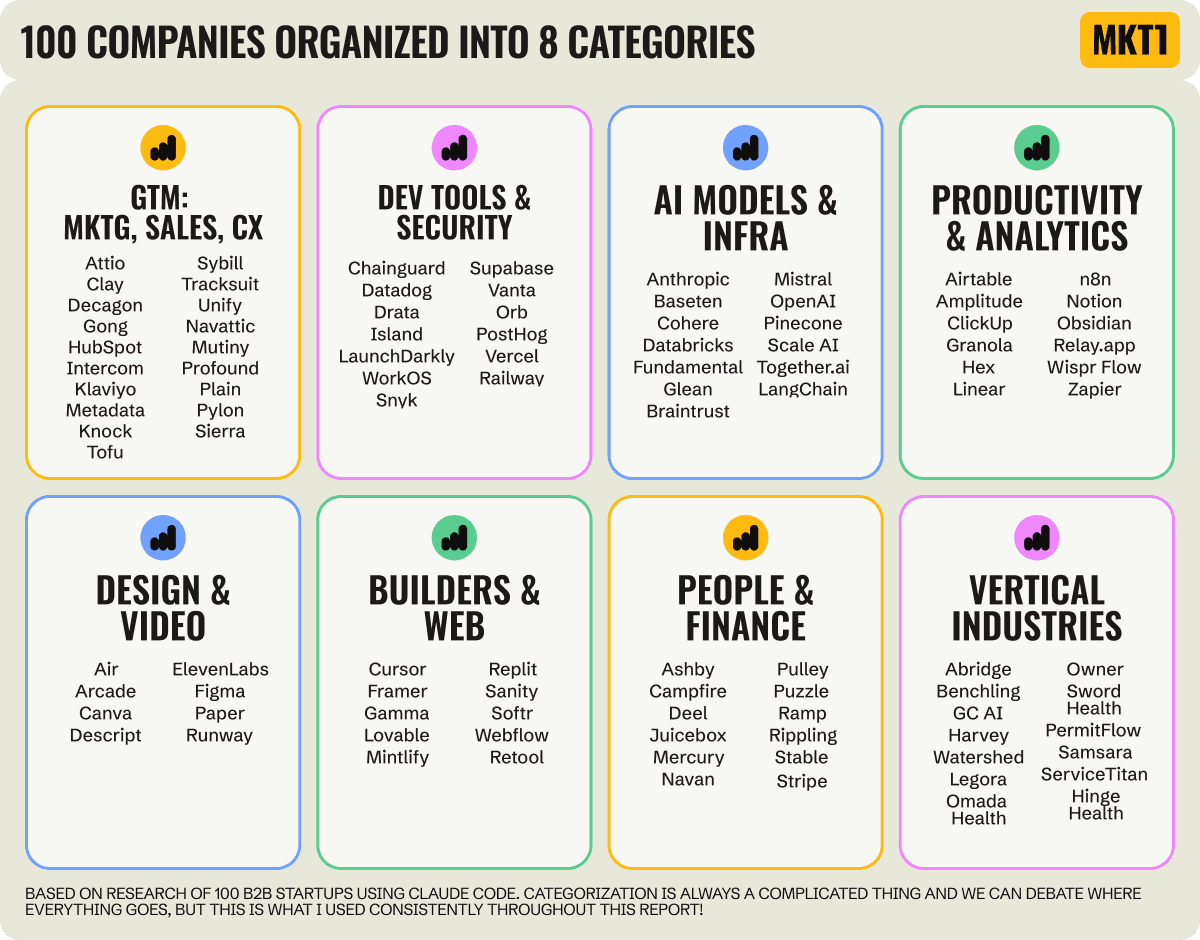
100 B2B Startups, 100+ Stats, and 14 Graphs on Web, Social, and Content
This is Part 2 of MKT1's three-part State of B2B Marketing Report. Where Part 1 looked at teams and leadership , Part 2 turns to what marketing teams are actually doing — what their websites look like, how they use social, and what "content fuel" they're producing. Emily Kramer u
Apr 28 · 10m
Lenny's Newsletter (Lenny's Podcast)
Why Half of Product Managers Are in Trouble — Nikhyl Singhal on the AI Reinvention Threshold
Nikhyl Singhal is a serial founder and a former senior product executive at Meta, Google, and Credit Karma . Today he runs The Skip ( skip.show (https://skip.show)), a community for senior product leaders, plus offshoots like Skip Community , Skip Coach , and Skip.help . Lenny de
Apr 27 · 7m

The AI Corner
The AI Agent That Thinks Like Jensen Huang, Elon Musk, and Dario Amodei
Dominguez opens with a claim that is easy to skim past but worth stopping on: the difference between elite founders and everyone else is not raw IQ or speed — it is that each of them has internalized a repeatable mental procedure they run on every important decision. The procedur
Apr 27 · 6m